Introduction
Selecting the wrong pneumatic solenoid valve isn’t just a fitting issue—it determines whether your cylinder resets safely or crashes dangerously during a power outage.
If you’ve ever looked at a pneumatic circuit diagram and felt confused by numbers like 3/2, 5/2, or 5/3, you are not alone. These numbers describe the valve’s function, but choosing between them requires understanding exactly how you want your cylinder to move and behave when power is lost.
In this guide, we will decode these “ways” and “positions” to help you select the right directional control valve for your specific application—whether it’s a simple air blow-off or a complex safety circuit.
Part 1: The Basics: Decoding “Ways” and “Positions”
Before diving into specific models, we need to understand the naming convention. Pneumatic valves are named using two numbers separated by a slash (e.g., 5/2 Way).
- The First Number (Ports/Ways): This refers to the number of connection ports on the valve body (Input, Output, Exhaust).
- The Second Number (Positions): This refers to the number of switching states the valve can be in (e.g., Open, Closed, Extended, Retracted).
Think of it this way:
- Ports are the “doors” air can enter or exit through.
- Positions are the “rooms” or “states” the internal spool can move into.
!
Key Terms You Must Know:
- P (Pressure Port): Where compressed air enters (Supply).
- A / B (Working Ports): Where air flows out to the cylinder.
- R / S (Exhaust Ports): Where air is released into the atmosphere (often fitted with silencers).
Pro Tip: Don’t confuse “Ways” with “Ports.” In casual industry speak, a “3-Way Valve” usually means a valve with 3 ports.
Part 2: The 3/2 Way Valve: Master of Single-Acting Cylinders
If you are controlling a Single-Acting Cylinder (a cylinder with one air port and a spring return), the 3/2 Way Pneumatic Solenoid Valve is your standard choice.
Why “3/2”?
- 3 Ports:
- P (Pressure): Supply inlet.
- A (Outlet): Connects to the cylinder.
- R (Exhaust): Vents air when the valve closes.
- 2 Positions: Open (Air flows to cylinder) and Closed (Air exhausts from cylinder).
Typical Applications
- Single-Acting Cylinders: Pushing a clamp or ejector that returns automatically via spring force.
- Air Blow-Off: Used as an air gun nozzle for cleaning chips or dust.
- Vacuum Control: Breaking a vacuum suction cup (requires a specific vacuum-rated valve).
!
The Critical Choice: Normally Closed (NC) vs. Normally Open (NO)
When selecting a 3/2 valve, you must decide its default state when the power is OFF:
- Normally Closed (NC) – Most Common & Safest:
- Power OFF: The valve blocks air from P. The cylinder connects to Exhaust (R) and retracts (spring return).
- Power ON: The valve opens, air flows to A, extending the cylinder.
- Safety Note: If the power fails, the system resets to a safe, retracted state.
- Normally Open (NO):
- Power OFF: Air flows freely to the cylinder, keeping it extended.
- Power ON: The valve closes, and the cylinder retracts.
- Use Case: Applications where the cylinder must hold a load even during a power outage.
Key Takeaway: For 90% of automation tasks involving grippers, clamps, or simple pushers, a 3/2 Way Normally Closed (NC) Solenoid Valve is the correct specification.
Part 3: The 5/2 Way Valve: The Industry Workhorse
If you need to control a Double-Acting Cylinder (one that uses compressed air to both extend and retract), the 5/2 Way Pneumatic Solenoid Valve is the industry standard.
Why “5/2”?
- 5 Ports:
- Port 1 (P): Air Supply Inlet.
- Port 2 (B) & Port 4 (A): Work ports connecting to the cylinder (Extend/Retract).
- Port 3 (S) & Port 5 (R): Exhaust ports (usually fitted with silencers to reduce noise).
- 2 Positions:
- Position 1: Air flows P->A (Cylinder Extends), B exhausts to S.
- Position 2: Air flows P->B (Cylinder Retracts), A exhausts to R.
!
The Critical Decision: Single Solenoid vs. Double Solenoid
When buying a 5/2 valve, you will face a choice that affects both safety and control logic:
1. Single Solenoid (Mono-stable / Spring Return)
- How it works: The valve has one coil and a mechanical spring. When you energize the coil, the valve switches. When you cut the power, the spring automatically pushes the spool back to its original position.
- Power Loss Behavior: The cylinder immediately resets to its “Home” position.
- Best For: Safety-critical applications. For example, a clamp that must open (release) if the power fails to prevent injury.
2. Double Solenoid (Bi-stable / Memory Valve)
- How it works: The valve has two coils and no return spring. It uses a pulse of electricity to switch positions and stays there until the other coil is energized.
- Power Loss Behavior: The valve “remembers” its last position. The cylinder stays where it was (until air pressure is lost).
- Best For: Long-duration tasks where you don’t want to keep the coil energized (energy saving), or applications where the cylinder must not reset unexpectedly.
⚠️ WARNING: Do you have enough pressure? Most 5/2 solenoid valves are Internally Piloted. This means they use the air pressure itself to help move the spool. They typically require a minimum of 0.15 MPa (approx. 20 PSI) to operate.
- If you are controlling low-pressure air, vacuum, or gravity-fed fluids, the valve will NOT switch. You must specify a Direct Acting valve instead.
Part 4: The 5/3 Way Valve: Precise Control & Mid-Position Stops
While 5/2 valves are great for moving a cylinder from one end to the other, what if you need to stop the cylinder in the middle of its stroke?
This is where the 5/3 Way Pneumatic Solenoid Valve shines.
Why “5/3”?
- 5 Ports: Same configuration as the 5/2 valve (P, A, B, R, S).
- 3 Positions:
- Position 1 (Left Coil ON): Cylinder Extends.
- Position 2 (Right Coil ON): Cylinder Retracts.
- Position 3 (Both Coils OFF): The Center Position.
Unlike a 5/2 valve, a 5/3 valve uses centering springs. When power is lost to both coils, the springs force the spool back to the Center (Neutral) position.
!
The “Big Three” Center Types: Which One Do You Need?
The behavior of the cylinder in that center position depends entirely on the spool design. You must choose between three types:
**1. Closed Center (All Ports Blocked) – The “Handbrake” **
- How it works: In the center position, all ports (P, A, B, R, S) are blocked. Air is trapped inside the cylinder on both sides.
- The Benefit: The cylinder stops immediately and holds its position (like a hydraulic lock).
- Safety Scenario (Vertical Load):
Imagine a heavy robotic arm lifting a box. If the power cuts out, a standard 5/2 valve might let the arm drop, crushing what’s underneath. A 5/3 Closed Center valve traps the air, “freezing” the arm in mid-air to prevent injury.
**2. Exhaust Center (A & B to Exhaust) – The “Neutral Gear” **
- How it works: In the center position, the supply (P) is blocked, but both working ports (A & B) are connected to the exhausts (R & S). All pressure is released from the cylinder.
- The Benefit: The cylinder becomes “limp.” You can manually push or pull the piston rod by hand.
- Best For: Situations where you need to safely clear a jam or manually position a workpiece when the machine is stopped.
**3. Pressure Center (P to A & B) – Rare **
- How it works: Supply pressure is sent to both sides of the cylinder simultaneously.
- The Benefit: Used for specific balancing applications or when you need to hold a cylinder against an external force using differential area pressure. (Much less common than the first two).
Summary:
- Want to hold the load? Choose Closed Center.
- Want to move the load by hand? Choose Exhaust Center.
Part 5: Summary Table: Quick Selection Guide
Need a quick answer? Here is the breakdown of the key differences between 3/2, 5/2, and 5/3 Way Pneumatic Valves.
| Valve Type | Cylinder Type | Solenoid Type | Power Loss Behavior | Typical Application |
|---|---|---|---|---|
| 3/2 Way | Single-Acting | Single (NC) | Reset (Retract) | Air Guns, Clamps, Ejectors |
| 5/2 Way | Double-Acting | Single | Reset (Home) | Safety Gates, Pushers |
| 5/2 Way | Double-Acting | Double | Hold Last Position | Memory Logic, Long Strokes |
| 5/3 Way | Double-Acting | Double | Stop in Center | Positioning, Vertical Lifts |
Selection Rule of Thumb:
- If it has a spring (Single Acting) -> 3/2 Way
- If it uses air to push/pull (Double Acting) -> 5/2 Way
- If it needs to stop mid-stroke -> 5/3 Way
Part 6: How to Specify Your Valve (Buying Guide)
Once you know the type (e.g., 5/2 Way Single Solenoid), you need to specify the details to ensure it fits your machine.
Checklist for Ordering:
- Voltage:
- 24VDC: The standard for modern PLC automation.
- 220VAC / 110VAC: Common in older systems or standalone machines.
- 12VDC: Often used in mobile equipment (trucks, agriculture).
- Port Size & Thread:
- NPT: Standard in North America (tapered).
- G (BSP): Standard in Europe and Asia (parallel).
- Size: 1/8″, 1/4″, 3/8″, 1/2″. (Make sure the Cv / Flow Rate matches your cylinder speed requirements).
- Mounting Style:
- Inline: Ports are on the valve body itself. Good for single repairs.
- Manifold Mount: Valve has no ports; it bolts onto a block. Essential for saving space in cabinets.
- NAMUR: Mounts directly onto a rotary actuator (for ball/butterfly valves).
- Manual Override:
- Always look for a valve with a Manual Override Button. This allows you to test the cylinder without electrical power—a lifesaver for maintenance.
💡 Expert Tip: Don’t Forget the Accessories!
A valve isn’t a standalone island. To ensure long life and compliance:
- Silencers (Mufflers): Installed on Exhaust ports (R & S) to reduce noise and prevent dust from entering the spool.
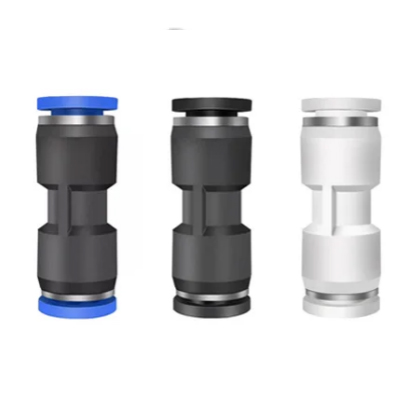
- Push-to-Connect Fittings: For quick tubing installation.
- Speed Controllers: Installed on the cylinder to control how fast the valve moves the load.
Part 7: Troubleshooting: Why is My Valve Stuck?
Is your new valve not working? Before you return it, check these three common issues:
1. The “Pilot Pressure” Trap
- Symptom: The coil lights up, you hear a click, but the cylinder doesn’t move.
- Cause: Most 5/2 valves are Internally Piloted. They need at least 20-30 PSI (0.15 MPa) of air pressure to shift the spool.
- Fix: Check your supply pressure. If you are controlling low pressure or vacuum, swap to a Direct Acting valve.
2. The Leaking Exhaust
- Symptom: Air is constantly hissing out of the exhaust port (R or S).
- Cause: It might not be the valve! Often, the cylinder’s internal piston seal is worn out. Air bypasses the piston inside the cylinder, flows back up the line, and exits through the valve.
- Fix: Disconnect the air line from the cylinder to the valve. If air comes out of the cylinder port, replace the cylinder seals.
3. The Burnt Coil
- Symptom: The solenoid is extremely hot or smells burnt.
- Cause: Wrong voltage (plugging 24V coil into 110V) or the armature is stuck (AC coils only).
- Fix: Ensure your power supply matches the coil label exactly.
Conclusion
Understanding the difference between 3/2, 5/2, and 5/3 way pneumatic solenoid valves is the first step toward building a safe and efficient automation system.
- Use 3/2 valves for single-acting simplicity.
- Use 5/2 valves for standard double-acting motion.
- Use 5/3 valves when you need precise stopping control or safety holding.
Ready to select your valve? Contact our engineering team if you are unsure which “Center Position” is right for your load.