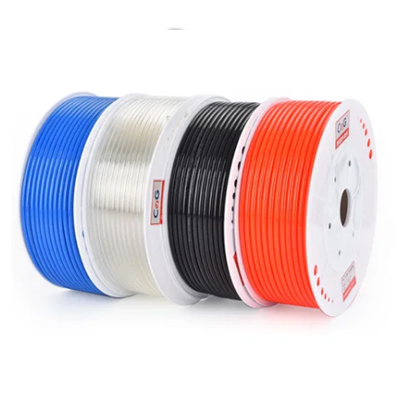
In the world of modern manufacturing, the trend is undeniable: machines are getting faster, smarter, and significantly smaller. As engineers strive to design increasingly compact automation systems—from intricate pick-and-place robots to densely packed control cabinets—every millimeter of internal real estate becomes a premium asset.
Engineers often spend weeks optimizing the placement of PLCs, valves, and actuators. Yet, the humble pneumatic tubing that powers these components is frequently treated as an afterthought—something to be “routed later” once the mechanical design is fixed.
This is where the trouble begins.
When you attempt to force standard, stiff industrial tubing into these shrinking footprints, physics fights back. The result is often the engineer’s nightmare: kinking.
A kinked tube is not just a cosmetic issue; it is a functional failure. It chokes airflow, starves actuators of power, and creates stress points that lead to premature leaking. In a high-speed automation environment, a single blocked air line can cause an entire production line to stop, turning a low-cost component into a high-cost liability.
To build reliable compact machines, we need to stop treating air lines as simple commodities and start treating them as precision mechanical components. The secret lies in understanding one critical metric: Bend Radius.
What is Minimum Bend Radius?
In technical terms, the minimum bend radius is the smallest radius a tube can be bent around without kinking, flattening, or sustaining structural damage. It is typically measured to the inside curvature of the tube. As a general rule of thumb for standard tubing, the minimum bend radius is often calculated as 5 to 10 times the tube’s outer diameter, depending on the material flexibility.
The Hidden Danger: Ovalization and Flow Attenuation
Most engineers only worry about “kinking”—the point where the tube folds over on itself and completely blocks airflow. However, in compact automation, the real enemy is often more subtle: Ovalization.
Before a tube kinks, it flattens into an oval shape as it is forced into a tight radius. This deformation reduces the internal cross-sectional area of the tubing.
Why does this matter?
- Flow Restriction: Even a 10-20% reduction in cross-sectional area causes significant air flow attenuation.
- Performance Drop: Your pneumatic actuators may still work, but they will move slower or with less force than calculated.
- Hard to Troubleshoot: Because the tube isn’t visibly “kinked,” technicians often waste hours checking valves and cylinders, not realizing the choke point is a slightly flattened tube buried deep in a cable track.
Respecting the bend radius isn’t just about preventing leaks; it’s about guaranteeing the flow rate required for your machine to run at peak cycle times.
Nylon vs. Polyurethane: The Material Battle
To solve the space challenge, we must look at the physics of the materials themselves. For decades, Nylon (Polyamide) has been the industry standard for pneumatic piping. It is strong, handles high pressure well, and is excellent for long, straight runs across a factory floor.
However, in the tight confines of compact automation, Nylon’s greatest strength—its rigidity—becomes its fatal flaw. Nylon resists bending. When you force it into a small radius, it fights back, leading to permanent kinks that destroy the tube’s structure.
Enter Polyurethane (PU): The Elastic Hero
For dynamic and compact applications, High-Flexibility Polyurethane (PU) tubing is the superior choice. Unlike Nylon, PU possesses rubber-like elasticity while maintaining the chemical resistance of plastic.
This gives PU tubing two distinct advantages:
- Elastic Memory: PU has excellent “memory.” If a robot arm bends the tube sharply during a rapid movement, high-quality PU tends to spring back to its original round shape rather than creasing permanently.
- Smaller Bend Radius: A standard 6mm PU tube can often achieve a bend radius that is 50% smaller than its Nylon counterpart, allowing you to route lines through impossibly tight corners without failure.
The “Side-Load” Factor: Saving Your Fittings
There is an often-overlooked benefit to using flexible PU: Fitting Protection.
When you force a stiff Nylon tube into a tight curve, it acts like a lever, exerting a constant “side-load” force on the push-to-connect fitting. Over time, this lateral tension pulls against the internal O-ring or gripping teeth of the fitting, creating a slow, frustrating leak that is difficult to diagnose.
Because high-flexibility PU tubing is compliant, it “relaxes” into the curve. It places minimal stress on the fitting connection, ensuring a leak-free seal even in the most cramped control boxes.
Deep Dive: Not All PU is Created Equal
Deciding to switch to Polyurethane is only step one. To truly optimize your compact automation design, you need to select the specific type of PU. Two tubes might look identical, but their performance in a tight, hot machine can be drastically different.
Here are the three critical specifications that savvy engineers check:
1. Shore Hardness: 98A vs. 95A
“Shore A” is the scale used to measure the hardness of flexible polymers.
- 98A (Standard): This is the most common PU tubing. It strikes a balance between pressure rating and flexibility.
- 95A or 90A (High-Flex): For extremely tight spaces, look for a lower durometer like 95A. It is softer and allows for an even tighter bend radius without kinking.
- Pro Tip: If you are routing tubing through a complex robotic wrist or a densely packed valve manifold, stepping down from 98A to 95A can be the difference between a smooth loop and a kinked line.
2. The Chemistry: Ether vs. Ester
This is the hidden killer of pneumatic lines. PU tubing generally comes in two chemical bases: Ether-based and Ester-based.
- Ester-based PU is cheaper but has a fatal flaw: it is prone to hydrolysis. In humid environments (or simply with moisture in the compressed air), it will eventually break down, turn brittle, and crumble.
- Ether-based PU is chemically engineered to resist moisture and hydrolysis. For any industrial machine intended to last, always specify Ether-based PU tubing. It costs slightly more but eliminates the risk of your tubing “rotting” from the inside out.
3. The “Heat Factor”: Temperature Derating
Here is the honest truth that many datasheets hide in the fine print: PU tubing gets weaker as it gets hotter. In compact automation, heat dissipation is often poor. Control cabinets can easily reach 40°C or 50°C. As the temperature rises, the flexibility of PU increases, but its ability to hold pressure decreases.
- The Rule: Always apply a pressure derating factor if your environment is hot. For example, a tube rated for 10 bar at 20°C might only be safe for 6 bar at 50°C. Ignoring this can lead to unexpected bursts even if the tube isn’t kinked.
Top Scenarios Where High-Flex Tubing is Non-Negotiable
While high-flexibility PU tubing is a premium choice, there are specific environments in compact automation where it is not just “nice to have,” but absolutely essential for system reliability.
- Robotic Arms and End-of-Arm Tooling (EOAT): Robotic arms represent the ultimate challenge for pneumatics. The tubing must survive millions of repetitive bending cycles while twisting and flexing with the robot’s joints. Standard tubing will fatigue and crack under this stress. High-flexibility PU, specifically designed for robotic applications, offers the fatigue resistance needed to prevent “work hardening” and failure during rapid pick-and-place operations.
- High-Density Control Cabinets: In modern control panels, space is money. Engineers are often forced to mount valve islands (manifolds) and PLCs in incredibly shallow enclosures. Using stiff tubing here creates a “spaghetti mess” that pushes against the door and stresses components. Soft, small-bend-radius tubing allows for tight, organized routing channels (wire ducts). It enables clean cable management that looks professional and makes future troubleshooting significantly easier.
- Cable Carriers (Drag Chains): Inside a moving drag chain, pneumatic lines are constantly rubbing against electrical cables and the chain links themselves. Here, flexibility is paired with abrasion resistance. A stiff tube that fights against the bend radius of the drag chain will wear out its outer jacket quickly due to friction. Flexible PU complies with the chain’s movement radius, reducing friction and extending the lifespan of the entire energy supply system.
Conclusion: The True Cost of “Cheap” Tubing
When designing a compact automation system worth tens of thousands of dollars, it is easy to overlook the cost of a few meters of air hose. But this is a dangerous calculation.
The true cost of a pneumatic tube isn’t the purchase price; it’s the Total Cost of Ownership (TCO). If a standard, stiff tube kinks inside a machine, the cost isn’t just the $1 to replace the tube. It is the cost of:
- Unplanned Downtime: The entire production line stopping for an hour.
- Labor: A technician dismantling a compact machine just to reach a buried air line.
- Reputation: The loss of trust when your machine fails at a customer’s site.
In the era of compact automation, High-Flexibility Ether-based PU Tubing is cheap insurance. It ensures that your sophisticated pneumatic circuits deliver the flow, pressure, and reliability they were designed for, no matter how tight the space.
Ready to Optimize Your Machine Design? Don’t guess when it comes to bend radius. Ensure your compact systems are plumbed for performance.
- [Download Our Pneumatic Tubing Catalog]: Compare the minimum bend radius of our High-Flex PU against standard Nylon.