Imagine this common scenario: You are a maintenance engineer in a modern manufacturing plant. On the left side of the aisle, you have a high-speed packaging machine imported from Germany. On the right, a conveyor system built in the USA.
A pneumatic line on the German machine bursts. In a rush to fix it, you grab a spool of tubing from the maintenance cage that “looks about right”—it says 1/4″ on the box. You push it into the machine’s fitting. It clicks in. The machine starts.
Two days later, the machine stops. The fitting is hissing, and the pressure has dropped.
Why? Because the German machine required 6mm tubing, not 1/4 inch (6.35mm). That invisible 0.35mm difference was enough to cause the internal O-ring to fail.
In the era of global sourcing, mixed standards are a reality. Whether you are an OEM designing for export or an MRO manager maintaining a hybrid fleet, understanding the nuances between Metric and Imperial pneumatic tubing is the only way to prevent chronic leaks and unplanned downtime.
The Golden Rule: It’s All About the O.D.
Before we dive into specific size comparisons, we must establish the most important rule of pneumatic sizing: Forget the Inner Diameter (I.D.).
Unlike hydraulic hoses or plumbing pipes which are often categorized by flow capacity (I.D.), pneumatic tubing used with push-to-connect fittings is sized by its Outer Diameter (O.D.).
Why O.D. Matters
Push-to-connect fittings rely on two internal components:
- The Collet (Gripping Teeth): Bites into the outside of the tube to hold it in place.
- The O-Ring: Seals around the outside of the tube to prevent air from escaping.
If your tubing O.D. is even slightly off spec (too small), the O-ring cannot create a seal. If it is too large, it may damage the collet or simply refuse to insert. Therefore, accurate measurement is non-negotiable. Put away the tape measure and use digital calipers.
Pro Tip: No Calipers? Use the “Fitting Gauge” Test If you can’t read the faded markings on a tube and don’t have calipers handy, use a brand-new fitting as a gauge.
- Keep a known 6mm fitting and a 1/4″ fitting in your toolbox.
- Try to insert the mystery tube. If it feels sloppy or loose, it’s likely the smaller metric size. If it jams or won’t bottom out, it’s likely the larger imperial size.
The “False Friends”: Sizes You Must NEVER Mix
The biggest source of confusion in the pneumatic world comes from sizes that look nearly identical to the naked eye but are mechanically incompatible. We call these “False Friends.”
The most notorious culprit is 6mm vs. 1/4 inch.
1. The 6mm vs. 1/4″ Trap
- Metric Size: 6.00 mm
- Imperial Size: 1/4 inch = 6.35 mm
- The Difference: 0.35 mm
To a layman, 0.35mm seems negligible. To a pneumatic fitting, it is a canyon.
- Scenario A: 6mm Tube in a 1/4″ Fitting The tube will insert easily—too easily. Because the tube is undersized by 0.35mm, the fitting’s internal O-ring cannot compress against the tube wall.
- Result: Immediate or slow leak. The tube may blow out under high pressure because the stainless steel teeth cannot bite into the undersized diameter.
- Scenario B: 1/4″ Tube in a 6mm Fitting The tube is oversized. You will struggle to push it in. If you force it, you might damage the release ring or the internal seal.
- Result: The tube jams and becomes impossible to remove, or the excessive stress causes the fitting body to crack over time.
Performance Note: The Flow Rate Nuance Even if you manage to seal a connection, swapping sizes affects performance. Replacing a 1/4″ line with a 6mm line reduces the internal cross-sectional area by roughly 12%. In high-speed automation (like sorting machines), this restriction can subtly slow down cylinder actuation times, throwing off your machine’s timing.
2. Other Dangerous Pairs
- 8mm vs. 5/16″ (7.94mm): The difference here is tiny (0.06mm). While you might get away with this in a low-pressure emergency, it is strictly non-compliant. At standard 100 PSI (7 bar) industrial pressure, this mismatch often leads to “micro-leaks” that waste expensive compressed air.
- 10mm vs. 3/8″ (9.52mm): The difference is 0.48mm. These are completely incompatible. Do not attempt to force them.
The “Safe Swap”: When You Can Cheat
After all those warnings, is there any exception? Yes. There is one “Safe Swap” widely accepted in the industry.
4mm vs. 5/32″
- Metric Size: 4.00 mm
- Imperial Size: 5/32 inch = 3.97 mm
- The Difference: 0.03 mm
The difference here is so microscopic (less than the thickness of a human hair) that it falls within the manufacturing tolerance of most high-quality push-to-connect fittings. Most major pneumatic manufacturers design their 4mm and 5/32″ fittings to use the exact same internal collet and O-ring.
- The Verdict: Interchangeable. You can safely use a 4mm tube in a 5/32″ fitting and vice-versa without fear of leaks or flow restriction. This allows you to consolidate inventory for small-diameter control lines.
Global Sourcing Strategy: Solutions for Mixed Fleets
If you are managing a facility with both metric and imperial equipment, “hoping for the best” is not a strategy. Here are three professional ways to manage the chaos:
1. The Hardware Fix: Metric-to-Imperial Adapters
Never force a mismatch. Instead, adapt it. Metric-to-Imperial Adapters (often called “conversion fittings”) are the cleanest solution. These fittings have a metric tube connection on one side (e.g., 6mm) and an imperial stem (e.g., 1/4″) on the other.
- Use Case: Connecting a new 6mm air line to an old 1/4″ port on a US-made machine. This ensures a leak-free seal on both ends.
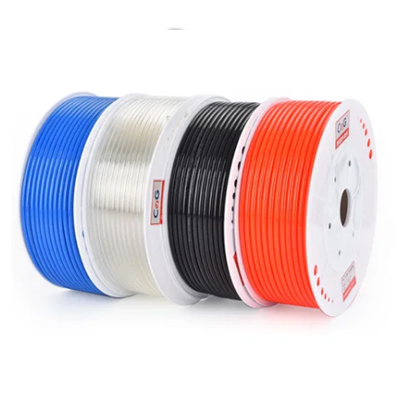
2. The Management Fix: Color Coding
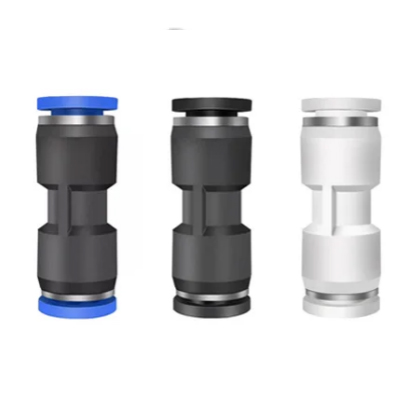
Visual management eliminates guessing. While there is no universal standard, some facilities assign specific colors to distinguish between Metric and Imperial sizes on the shop floor.
Others prefer to use color to distinguish circuit function—for example, using one color for supply lines and another for exhaust lines to simplify troubleshooting. Regardless of your method, consistency is key.
3. The “Hybrid” Approach: Isolate Your Systems
If possible, keep machine islands consistent. Don’t mix standards on a single machine frame.
Pro Tip: The Thread Trap Be careful when buying replacement cylinders or valves! A machine that uses Metric tubing usually requires BSPP (G-thread) or BSPT (R-thread) fittings. A machine with Imperial tubing almost always uses NPT threads. Buying a fitting that fits your tube but not your cylinder port is a common purchasing error. Always check the thread standard (Parallel vs. Tapered) before ordering.
Quick Reference: Pneumatic Tubing Size Conversion Chart
When you are on the shop floor, you don’t have time to do math. Use this chart to determine the actual Outer Diameter (O.D.) of common tubing sizes and check compatibility instantly.
| Metric Size | Actual O.D. (mm) | Closest Imperial | Imperial O.D. (mm) | Difference | Compatible? |
|---|---|---|---|---|---|
| 4 mm | 4.00 mm | 5/32″ | 3.97 mm | 0.03 mm | ✅ YES (Safe) |
| 6 mm | 6.00 mm | 1/4″ | 6.35 mm | 0.35 mm | ❌ NO |
| 8 mm | 8.00 mm | 5/16″ | 7.94 mm | 0.06 mm | ⚠️ RISKY (Avoid) |
| 10 mm | 10.00 mm | 3/8″ | 9.52 mm | 0.48 mm | ❌ NO |
| 12 mm | 12.00 mm | 1/2″ | 12.70 mm | 0.70 mm | ❌ NO |
Note: “Risky” means it might seal temporarily under low pressure but is not recommended for industrial standards.
Conclusion: Accuracy is Reliability
In the world of pneumatics, “close enough” is simply not good enough. While Metric and Imperial systems may coexist in the global supply chain, they cannot comfortably coexist in the same fitting without the right strategy.
Attempting to force a 6mm tube into a 1/4″ fitting might save you five minutes today, but it will cost you hours of downtime tomorrow when the seal inevitably fails.
Whether you choose to standardize your facility, implement color coding, or use conversion adapters, the key is consistency. Treat your pneumatic tubing with the same precision you treat your machined parts, and your machines will reward you with leak-free reliability.
Ready to Stop the Leaks? Don’t let sizing confusion slow down your operation. Contact us now!