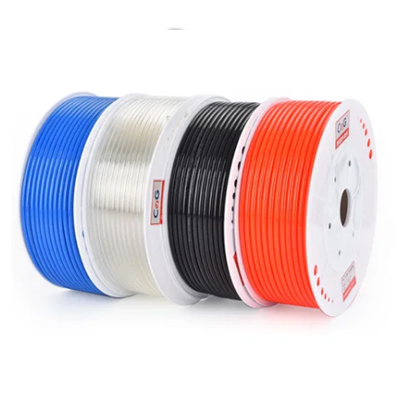
Open the door to an average pneumatic control cabinet, and what do you see?
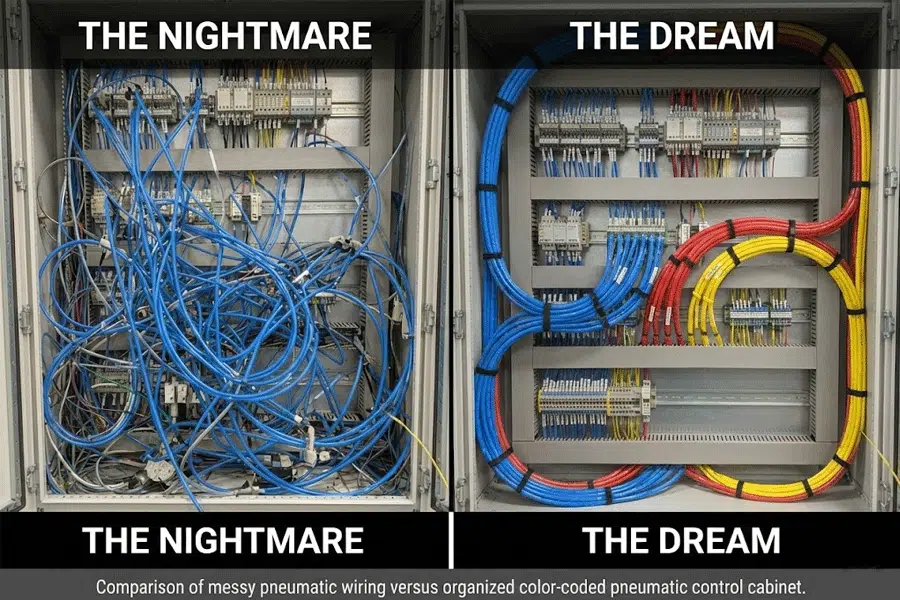
For many maintenance engineers, the answer is a nightmare: hundreds of blue pneumatic tubing tangled together like a bowl of spaghetti. Tracing a single line from a valve to a cylinder can take 15 minutes of frustrating “hand-over-hand” tracking.
This “Spaghetti Mess” is more than just an eyesore; it is a liability.
- Efficiency Killer: Troubleshooting time doubles when you can’t visually identify circuits.
- Safety Hazard: In a rush, a technician might cut what they think is an exhaust line, only to slice through a high-pressure supply line, creating a dangerous whipping hose risk.
Professional pneumatic circuit management—specifically through strategic color-coding—is not about making things look pretty. It is about applying Visual Management principles to make your machines safer, easier to maintain, and faster to build.
The Myth of “Standard Colors”
The first question most engineers ask is: “Is there an ISO standard for pneumatic tubing colors?”
The short answer is: No.
Unlike the electrical industry, where specific wire colors (like black for hot, white for neutral) are strictly regulated, the pneumatic industry has no universal standard for tubing colors. A blue tube can carry water, air, or vacuum depending on who installed it.
The Opportunity: Define Your Own Logic
While the lack of standards can cause confusion, it also presents an opportunity. It allows you to define a protocol that makes sense for your specific machinery.
Instead of coding by media (e.g., “Air vs. Water”), the most effective strategy for automation is to code by Function: distinguishing the power entering the system from the exhaust leaving it.
Strategy 1: The “Supply vs. Exhaust” Protocol
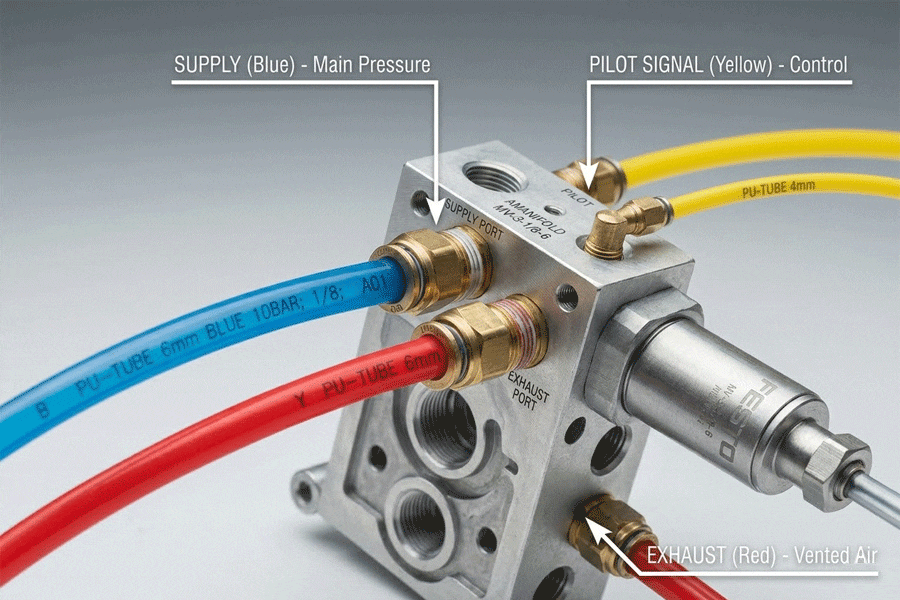
If you want to revolutionize how your team interacts with your machines, stop using one color for everything. Adopt the “Supply vs. Exhaust” Protocol.
This method uses color psychology to communicate the state of the energy within the tube.
1. Supply Lines (The Muscle)
- Recommended Colors: Blue or Black
- Function: These lines carry compressed air from the valve to the cylinder to perform work (extension or retraction).
- The Logic: In industrial design, darker/cooler colors often represent stability and standard power. Blue is the most readily available color, making it the perfect default for “Supply.”
2. Exhaust/Return Lines (The Release)
- Recommended Colors: Red or Orange
- Function: These lines carry air leaving the cylinder back to the valve or muffler.
- The Logic: Why Red? Because Red means “Warning.”
Safety Note: The Danger of Residual Pressure The biggest risk in pneumatic maintenance is Residual (Trapped) Pressure. Even after a machine is locked out, air can be trapped behind a cylinder piston. If a technician cuts a tube thinking it’s safe, the stored energy can cause the cylinder to lunge unexpectedly.
By coding Exhaust lines as Red, you give a visual warning: “Caution: This line may contain trapped pressure.” This simple visual cue forces technicians to think twice and verify zero energy before cutting.
3. Pilot & Signal Lines (The Brain)
- Recommended Colors: Yellow, Green, or Clear (often smaller diameter, e.g., 4mm)
- Function: Carrying low-flow signals to pilot valves or sensors.
- The Logic: Using a distinct, bright color helps distinguish these delicate control lines from the heavy-duty power lines.
Keeping it Together: Spiral Wraps & Cable Management
Implementing the “Supply vs. Exhaust” protocol implies running two separate tubes for every cylinder. If left loose, this can double the potential for tangles.
The solution? Bundle them effectively.
Using Spiral Wraps allows you to physically group the Supply (Blue) and Exhaust (Red) lines together for each specific cylinder, mimicking the cleanliness of a multi-core cable.
- Organized Tracing: By wrapping the pair, you create a single logical “cable” that is easy to route through drag chains and cable trays.
- Abrasion Protection: Spiral wraps add an extra layer of protection, preventing your tubing from rubbing against sharp metal edges in the machine frame.
- Pro Tip: Avoid using standard zip-ties (cable ties) too tightly! Overtightening a thin cable tie can crush the soft PU tube wall and restrict airflow. Spiral wrapping distributes the pressure evenly and allows for flexibility.
The OEM Advantage: Showroom Quality For Machine Builders (OEMs), internal cabling is your signature. A messy cabinet implies a messy design process. Using Spiral Wraps to bundle color-coded pairs creates a sleek, professional look that instantly elevates the perceived value of your machine. It tells your customer: “We pay attention to every detail.”
Strategy 2: Coding by Physics (Not Just Looks)

Sometimes, the environment dictates the color. Beyond circuit function, certain tubing colors offer specific physical properties that are critical for longevity and maintenance.
1. Transparency = Visual Inspection
- Recommended: Clear or Transparent Blue/Red
- Use Case: Downstream of your FRL (Filter-Regulator-Lubricator) unit.
- Why: Clear tubing is your window into the air quality. It allows you to visually spot contamination—like oil sludge or accumulated water—before it destroys your expensive valves. If you use solid black tubing everywhere, you are flying blind.
2. Black = UV Protection
- Recommended: Black
- Use Case: Any outdoor equipment or areas near UV curing lamps.
- Why: Black tubing is typically infused with Carbon Black, which acts as a natural UV stabilizer. While clear or blue tubing will become brittle and crack after a few months in the sun, black tubing can survive for years.
Installation Tips for the “Pro” Look
Color coding is only half the battle. To achieve a truly professional installation, you need the right finishing touches.
- The Tools: Never use scissors or side cutters to trim your tubing. They crush the tube profile into an oval, causing immediate leaks. Always use a dedicated Tube Cutter for a perfect 90-degree square cut.
- The Bundle: For loose bundles of pilot lines (e.g., a group of 6 yellow tubes), use Spiral Wrap. It protects the tubing from abrasion and keeps the bundle tight, mimicking the cleanliness of a multicore cable.
Pro Tip: The “Legend Plate” If you implement a color-coding system, don’t keep it a secret. Stick a small Color Key label inside the control cabinet door (e.g., “Blue=Supply, Red=Exhaust”). This ensures that five years from now, a new maintenance technician will immediately understand your system’s logic instead of guessing.
Conclusion: Organization is an Investment, Not a Chore
It is easy to look at a spool of Twin Tubing or a roll of Spiral Wrap and think, “Is this extra cost really worth it?”
But consider the alternative. The cost of a “Spaghetti Mess” is hidden, but it is real. It is paid in the currency of downtime hours when a technician can’t find a leak. It is paid in safety incidents when a high-pressure line is cut by mistake. And for OEMs, it is paid in the lost reputation of shipping a machine that looks unfinished.
By adopting a Function-Based Color Protocol—specifically the “Supply vs. Exhaust” strategy—you are not just organizing wires; you are engineering safety and efficiency into the DNA of your machine.
Ready to Clean Up Your Act? Transform your pneumatic circuits from chaotic to world-class. Get Contact with us!