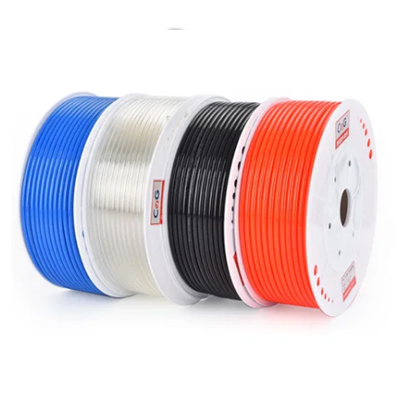
When a pneumatic cylinder actuates too slowly, the instinct of many operators and junior engineers is to apply the “bigger is better” philosophy. The logic seems sound at first glance: If I use a larger diameter pneumatic tube, more air will flow through it, and the cylinder will move faster. However, in the physics of fluid power, this assumption is fundamentally flawed.
Up-sizing your air hoses without calculation often makes the problem worse, leading to sluggish machine response and a massive waste of compressed air. In this article, we will explore the concept of “Right-Sizing,” explain the hidden enemy known as “Dead Volume,” and guide you on how to match the perfect tubing size to your pneumatic fittings and actuators.

The Hidden Enemy: What is “Dead Volume”?
To understand why bigger isn’t always better, you must first understand pneumatic dead volume.
Dead volume is the total empty space inside the pneumatic tubing between the control valve (solenoid valve) and the actuator (cylinder). When a valve shifts to actuate a cylinder, the compressed air doesn’t instantly push the piston. First, the air must fill up all that empty space inside the tube and build up enough pressure to overcome the cylinder’s resting friction.
Slower Response Times
If you replace a standard 6mm tube with a massive 12mm tube, you exponentially increase the internal volume. Now, every time the valve opens, the compressor has to fill a much larger “balloon” before the cylinder even begins to move. This results in a noticeable delay—a sluggish pneumatic cylinder response time that can ruin the synchronization of high-speed automated machinery.
Wasted Compressed Air on Exhaust
The inefficiency doesn’t stop when the cylinder extends. When the valve shifts back to retract the cylinder, all the pressurized air trapped inside that oversized tube is simply exhausted into the atmosphere. The larger the tube, the more expensive compressed air you waste on every single cycle.
Pressure Drop vs. Tubing Diameter: Finding the Sweet Spot
Right-sizing is about finding the perfect balance. You don’t want a tube that is too large, but you also must avoid one that is too small.
- Too Small = Starved Actuators: If the internal diameter (ID) of the tubing is too narrow for the required airflow, it creates severe air friction. This leads to a massive pneumatic pressure drop. By the time the air reaches the cylinder, the dynamic pressure may have dropped from 90 PSI to 60 PSI, resulting in a weak, underpowered stroke.
- The Sweet Spot: The goal is to select the smallest possible tubing diameter that still allows enough airflow (CFM or L/min) to meet the cylinder’s speed requirements without causing an unacceptable pressure drop.
Beyond Airflow: The Flexibility and Routing Factor
Airflow isn’t the only reason engineers avoid oversized tubing. In modern machine design, space is at a premium.
Larger diameter tubes have a much wider bend radius. If you try to force a thick, rigid hose into the tight confines of a control panel or a robotic arm, the tube will likely kink. A kinked tube completely chokes off the airflow, causing immediate machine failure.
By right-sizing to a smaller, highly flexible polyurethane (PU) pneumatic tubing, you ensure smooth routing, tight bends without kinking, and a much cleaner, professional-looking machine build.
Quick Reference: Pneumatic Tubing Sizing Guide
While complex nomograms exist for exact calculations, here is a general “Rule of Thumb” reference chart matching cylinder bore sizes to standard Metric (Outer Diameter) tubing sizes:
| Cylinder Bore Size (Diameter) | Recommended Tubing OD (Metric) | Recommended Tubing OD (Imperial) |
|---|---|---|
| Micro Cylinders (10mm – 16mm) | 4mm | 5/32″ |
| Small Cylinders (20mm – 25mm) | 6mm | 1/4″ |
| Standard Cylinders (32mm – 50mm) | 8mm | 5/16″ |
| Large Cylinders (63mm – 80mm) | 10mm or 12mm | 3/8″ or 1/2″ |
(Note: If the distance between the valve and the cylinder is exceptionally long—e.g., over 5 meters—you may need to increase the tubing size by one step to compensate for friction loss.)
How to Match Your Tubing with the Right Components
Once you’ve determined the correct size, you must ensure it matches your connection hardware perfectly. Here is the most common mistake made in procurement: Confusing ID (Inner Diameter) with OD (Outer Diameter).
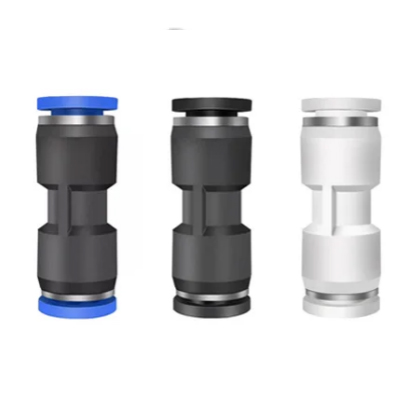
Modern pneumatic push-in fittings (the quick-connect style most factories use) are designed to seal against the Outside Diameter (OD) of the tubing.
- If you buy an “8mm push-in fitting,” you must buy tubing with an 8mm OD.
- The Inner Diameter (ID) will vary based on the tubing wall thickness and material (such as Nylon vs. PU), but the fitting only cares about a precise, leak-free grip on the outside.
Choosing the Right Material
- PU (Polyurethane) Tubing: The industry standard. Highly flexible, kink-resistant, and perfect for moving parts and tight spaces.
- Nylon Tubing: More rigid and less flexible than PU, but offers superior resistance to high pressures, chemicals, and temperature. Ideal for main supply lines.
Conclusion
Right-sizing your pneumatic tubing is a critical step in building efficient, responsive, and leak-free automated systems. Remember the rule: As small as possible, but as large as necessary. Don’t let dead volume slow down your machines and inflate your energy bills.
Need Help Selecting the Right Connections?
Whether you need highly flexible PU tubing for tight robotic routing or premium leak-free push-in fittings to secure your exact OD dimensions, we have the inventory and expertise you need. [Click here to explore our pneumatic tubing and fittings catalog.]