In the traditional world of pneumatics, control is often binary. A standard solenoid valve is either fully open or fully closed. In engineering terms, this is sometimes jokingly referred to as “bang-bang” control.
While this simple On/Off logic is perfectly fine for basic tasks like pushing a box off a conveyor belt, modern automation demands finesse. What if you need to gently grip a fragile glass tube? What if you need a cylinder to accelerate smoothly, hold a specific speed, and decelerate without jerking?
This is where the standard directional valve falls short, and the electro-pneumatic proportional valve steps in. In this guide, we will explore how proportional valves work, compare them to standard on/off valves, and explain why upgrading your control logic is essential for high-precision manufacturing.
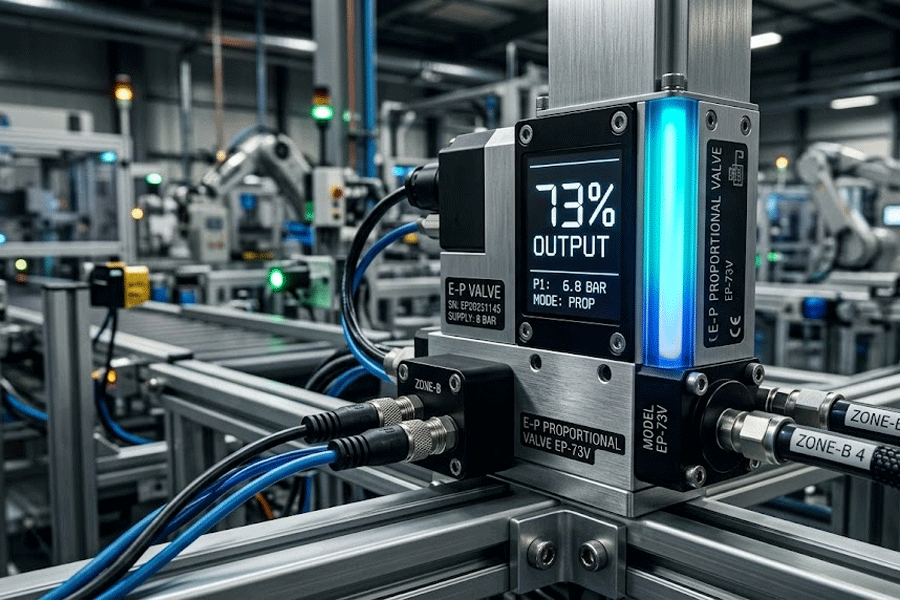
The “Dimmer Switch” Analogy: How Proportional Valves Work
The easiest way to understand a proportional valve is to look at the lighting in your home.
A standard On/Off valve is like a traditional light switch. You flip it, and the light is 100% on. You flip it down, and it’s 0% off. There is no in-between.
A proportional solenoid valve, however, is like a dimmer switch. By turning a dial, you can set the light to 20%, 45%, or 87% brightness. In a pneumatic circuit, instead of a manual dial, the valve receives an analog electrical signal from a PLC (Programmable Logic Controller).
Inside the valve, a specialized solenoid coil generates a magnetic field that is proportional to the electrical input. Instead of snapping the valve spool all the way open, the magnetic force suspends the spool or plunger in a partially open position. This allows for continuous, infinite control over the compressed air passing through it.
Proportional vs. On/Off Valves: When to Make the Switch
Should you upgrade? Here is a quick comparison to help you decide:
| Feature | Standard On/Off Solenoid Valve | Proportional Solenoid Valve |
|---|---|---|
| Control Logic | Binary (0% or 100%) | Continuous (0% to 100%) |
| Response | Abrupt, instantaneous shift | Smooth, variable acceleration/deceleration |
| Complexity | Simple wiring, basic PLC output | Requires analog PLC output (e.g., 0-10V) |
| Best Used For | Clamping, basic extending/retracting, blowing air | Tension control, precise force application, variable speed profiles |
The Two Main Types of Pneumatic Proportional Control
When sourcing components, you must determine what physical property you actually need to control. Proportional valves generally fall into two distinct categories:
1. Proportional Pressure Regulators (Controlling “Force”)
These valves control the output pressure regardless of fluctuating input pressure or varying flow rates.
- Application: Imagine a robotic gripper handling delicate fruits. A proportional pressure regulator can dynamically adjust the gripping pressure via the PLC. It applies low pressure for soft berries and instantly scales up to higher pressure for sturdy apples, all using the same cylinder.
2. Proportional Flow Control Valves (Controlling “Speed”)
These valves adjust the size of the orifice, controlling the volume of air passing through in a given timeframe.
- Application: If you have a heavy sliding door or a massive cutting blade, a variable flow solenoid valve allows you to slowly accelerate the movement, hold a steady speed, and then gently decelerate before the end of the stroke, eliminating mechanical shock and wear.
Understanding the Control Signals: 0-10V vs. 4-20mA
To make the valve spool hover at exactly 50% open, your PLC must send it an analog signal. In the industrial automation world, there are two universal standards:
- 0-10V DC (Voltage Control): Very common, easy to troubleshoot with a standard multimeter. However, voltage can drop over long cable runs, making it less ideal if the PLC is very far from the valve.
- 4-20mA (Current Control): The gold standard for robust industrial environments. Current does not drop over long distances, and it is highly resistant to electrical noise (EMI) from nearby motors. Furthermore, if a wire breaks, the signal drops to 0mA (outside the 4-20mA range), allowing the PLC to instantly detect a fault.
Pro Tip for Engineers: When evaluating premium proportional valves, always look at the hysteresis specification. High-quality valves feature extremely low hysteresis, meaning the valve orifice will return to the exact same physical position whether you are ramping the signal up or dialing it down.
Conclusion
Stepping beyond simple on/off control unlocks a new realm of precision for your pneumatic systems. While electro-pneumatic proportional valves require a higher initial investment and more sophisticated programming, they eliminate jerky movements, reduce mechanical wear, and allow a single machine to adapt to multiple tasks on the fly.
Ready for Precision Control?
If your application demands smooth, continuous, and repeatable performance, it is time to upgrade. Explore our premium range of 0-10V and 4-20mA proportional pressure regulators and flow valves, engineered for exceptionally low hysteresis and fast response times. [Click here to view the catalog or consult our engineering team.]