The most expensive component in your pneumatic system isn’t the compressor or the cylinder—it’s the leak.
While a pneumatic fitting (or air fitting) represents a tiny fraction of your machine’s total budget, a failure here can bring an entire production line to a halt. Whether you are a procurement manager sourcing for a factory or an engineer designing a new automation system, the challenge is always the same: balancing cost against durability.
Choose a fitting that is too cheap, and you risk air leaks, frequent replacements, and safety hazards. Choose one that is “over-engineered,” and you unnecessarily inflate your project costs.
So, how do you decide?
In this guide, we move beyond basic definitions. We will compare the three industry standards—Plastic (Composite), Brass, and Stainless Steel—based on real-world performance data. By the end of this article, you will know exactly which material provides the best ROI (Return on Investment) for your specific application environment.
The Quick Decision Matrix: A Snapshot Comparison
Short on time? Use this cheat sheet to quickly match the material to your application requirements. While detailed specifications vary by manufacturer, this matrix represents the industry standard.
| Feature | Plastic (Composite) | Nickel-Plated Brass | Stainless Steel (316) |
|---|---|---|---|
| Cost | $ (Low) | $$(Medium) | $$$$ (High) |
| Durability | Good | Excellent | Superior |
| Pressure Rating | Low to Medium | High | Extreme |
| Corrosion Resistance | Low (Susceptible to UV) | Good (Resists Oxidation) | Best (Chemicals/Washdown) |
| Weight | Extremely Light | Medium | Heavy |
| Ideal Application | Textile, Light Automation | General Industry, Automotive | Food & Beverage, Medical, Marine |
Pro Tip: “Cost” isn’t just the purchase price. A cheap plastic fitting that causes a factory shutdown due to cracking is infinitely more expensive than a stainless steel one. Always calculate the Total Cost of Ownership (TCO) based on your environment.
Plastic Pneumatic Fittings: The Lightweight & Economy Choice

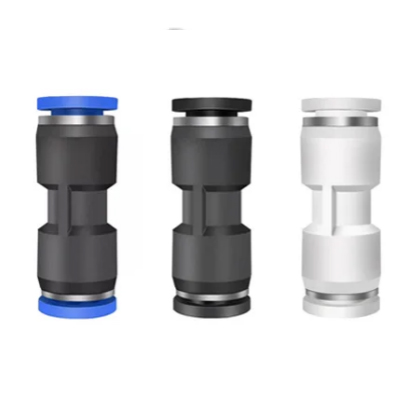
When we say “plastic fittings,” we are typically referring to Push-to-Connect fittings made from high-quality thermoplastics like PBT (Polybutylene Terephthalate). These are the most common type found in light industrial applications today.
It is important to note that modern plastic fittings are rarely “100% plastic.” Most high-quality units feature a hybrid construction: a lightweight PBT body paired with Nickel-plated brass threads. This design gives you the best of both worlds—the economy of plastic and the connection strength of metal to prevent thread stripping during installation.
The Pros (Why Choose Plastic?)
- Cost-Effective: They are significantly cheaper than full metal options, making them ideal for machines requiring hundreds of connection points.
- Lightweight: For applications like robotic arms or moving gantries, every gram counts. Plastic fittings reduce the inertial mass, allowing for faster cycle times.
- Color-Coding: The release rings (blue, black, orange) help technicians easily identify metric vs. imperial sizes or different pressure lines.
The Cons (Where to Avoid)
- UV Sensitivity: Standard plastic fittings can become brittle and crack if exposed to direct sunlight (UV rays) over time.
- Lower Pressure Limits: While suitable for standard 150 PSI shop air, they are not designed for high-pressure hydraulic-like spikes.
- Physical Durability: In heavy-duty environments, a stray tool or impact can crack the plastic body.
Best For: Textile machinery, packaging equipment, electronics assembly, and general indoor automation.
Brass Pneumatic Fittings: The Industry Standard

If plastic is the economy choice, Brass is the robust workhorse of the pneumatic world. It strikes the perfect balance between cost, performance, and durability, making it the default choice for 70% of industrial applications.
However, a critical distinction must be made: we are specifically talking about Nickel-Plated Brass.
While “plain” brass is functional, premium manufacturers use nickel plating to enhance the fitting’s properties. This plating acts as a shield, preventing the copper in the brass from oxidizing (turning green) and providing a harder surface that resists scratches and wear.
The Pros (Why Choose Brass?)
- Exceptional Durability: Unlike plastic, a brass fitting will not crack if hit by a wrench or dropped. It offers superior vibration resistance, making it safer for air compressors and heavy machinery.
- Temperature Tolerance: Brass can withstand significantly higher temperatures than thermoplastics, ensuring the seal remains integrity even in hot engine bays or near furnaces.
- Thread Strength: Whether you are using NPT or BSPP threads, brass threads are less likely to cross-thread or deform during installation compared to plastic or aluminum.
The Cons (Where to Avoid)
- Chemical Incompatibility: While resistant to water and oil, brass is vulnerable to certain strong acids and ammonia.
- Weight: It is heavier than plastic, which might be a drawback for high-speed, weight-sensitive robotics.
Best For: Automotive manufacturing, air compressor systems, garage workshops, and general heavy-duty automation.
Stainless Steel Fittings: For Extreme Environments

When failure is not an option, or when hygiene is strictly regulated, Stainless Steel Pneumatic Fittings are the only viable solution. They represent the “insurance policy” of your pneumatic system.
While 304 Stainless Steel is common, for truly aggressive environments, we recommend 316 Stainless Steel. The addition of molybdenum in 316 steel dramatically increases its resistance to chlorides and acids, making it superior for marine and chemical processing applications.
The Pros (Why Choose Stainless Steel?)
- Ultimate Corrosion Resistance: Whether it is saltwater spray on an oil rig or acidic fumes in a chemical plant, stainless steel will not rust or degrade.
- Washdown Ready (Hygiene): In the Food & Beverage and Pharmaceutical industries, equipment is frequently blasted with high-pressure, caustic cleaning agents to kill bacteria. Stainless steel fittings (often FDA compliant) withstand this “washdown” process without leaching chemicals or corroding.
- High-Temperature & Pressure: Stainless steel maintains its structural integrity at temperatures and pressures that would melt plastic and deform brass.
The Cons (Where to Think Twice)
- High Initial Cost: These fittings can cost 3x to 5x more than brass. However, if they last 10 years instead of 6 months, the Long-Term ROI is undeniable.
- Weight & Hardness: They are heavy and the material hardness makes them slightly more difficult to install if using compression fittings (requires more torque to seal).
Best For: Food & beverage processing, pharmaceutical manufacturing, marine/offshore applications, and semiconductor cleanrooms.
Critical Comparison Factors: How to Decide?
Choosing the right material isn’t just about preference; it is about physics and economics. Here is how the three materials stack up against specific engineering challenges.
1. Pressure & Temperature Relationship
This is the most common oversight in system design.
- Plastic: While rated for standard pressures (e.g., 150 PSI), plastic’s strength is inversely proportional to temperature. As the environment heats up (above 60°C/140°F), plastic softens, drastically reducing its burst pressure rating. A plastic fitting that works fine in a cool morning might fail during a hot afternoon shift.
- Metal (Brass/SS): Metal maintains its structural integrity across a much wider temperature range. If your application involves heat—such as near injection molding machines or drying ovens—metal is the mandatory choice to prevent catastrophic blowouts.
2. Environmental Stress: Vibration & Impact
- Vibration: Pneumatic systems on heavy machinery vibrate constantly. Over millions of cycles, plastic fittings can suffer from fatigue failure, leading to micro-cracks at the connection point. Brass and Stainless Steel compression fittings offer superior vibration resistance, ensuring the “grip” on the tube remains tight.
- Physical Hazards: In a welding shop, flying sparks (weld spatter) will melt a standard plastic fitting instantly. Here, you must use All-Metal fittings (often Stainless Steel or special Weld-Spatter Resistant Brass) to survive.
3. The Economics: Upfront Price vs. Total Cost of Ownership (TCO)
Don’t be fooled by the sticker price.
- Scenario A: You buy a $1.00 plastic fitting for a washdown environment. It corrodes and leaks every 3 months. In one year, you spend $4.00 on parts + $200.00 on maintenance labor + $1,000.00 on lost production time.
- Scenario B: You buy a $10.00 Stainless Steel fitting. It lasts 10 years.
- Verdict: For critical or harsh applications, the “expensive” stainless steel fitting is actually the cheapest option.
Troubleshooting: Common Causes of Fitting Failures
Before you blame the material, check your installation. 80% of “fitting failures” are actually installation errors. Here are the top 3 reasons your pneumatic system might be leaking:
1. The “Bad Cut” (Improper Tubing Preparation)

This is the #1 cause of leaks in Push-to-Connect fittings. If you use pliers or scissors to cut your PU or Nylon tubing, you deform the tube into an oval shape. This prevents the internal O-ring from creating a perfect seal.
- The Fix: Always use a proper Pneumatic Tube Cutter to ensure a perfectly square (90°), clean cut with no burrs.
2. Overtightening (The “Hulk” Effect)
With Brass NPT fittings, more torque does not equal a better seal. Because NPT threads are tapered, overtightening them acts like a wedge, which can crack the female port or strip the threads.
- The Fix: Tighten until “finger tight,” then give it 1-2 turns with a wrench. Use Teflon tape or thread sealant for a secure, leak-free connection.
3. Size Mismatch (Metric vs. Imperial)
Trying to force a 1/4″ tube (6.35mm) into a 6mm fitting will damage the internal lock claws.
Pro Tip: Don’t rely solely on color coding. Different manufacturers have different rules for identifying Metric vs. Imperial sizes (e.g., SMC, Festo, and others often use completely different color schemes).
- The Fix: Always verify the markings printed on the fitting body or consult the manufacturer’s catalog before installation. Never assume a color rule (like “Blue for Metric”) applies universally, as forcing a mismatch can damage the internal mechanism.
Conclusion: Which Material Wins?
There is no single “best” pneumatic fitting—only the best fitting for your specific application.
- Choose Plastic if you need a lightweight, low-cost solution for general indoor automation and standard pressures.
- Choose Nickel-Plated Brass if you need a durable, vibration-resistant industry standard that balances performance and price.
- Choose Stainless Steel if you operate in harsh environments (food, chemical, marine) where corrosion resistance and hygiene are non-negotiable.
Stop guessing and start optimizing.
Ready to Upgrade Your System?
Don’t let a $2 fitting cause a $2,000 shutdown.
- Download our 2026 Pneumatic Fittings Catalog: Browse our full range of Plastic, Brass, and 316 Stainless Steel components.
- Need technical advice? Contact our Engineering Team today for a free compatibility check on your specific application.