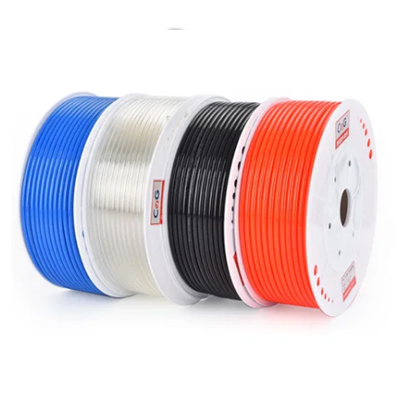
Walk onto any factory floor, and you will likely see a maintenance technician holding a roll of blue pneumatic tubing, eyeballing the distance between two valves, and making a quick snip. “Looks about right,” they say.
When the machine powers up, one of three things happens:
- The tube is too short, putting extreme tension on the fitting until it suddenly “pops” out.
- The tube is bent too sharply, kinking in the middle and cutting off 50% of the air flow.
- The tube is way too long, creating a massive coil of extra air volume that drastically slows down the pneumatic cylinder’s response time.
In industrial automation, pneumatic tube routing is a precise science, not a guessing game. Getting the length wrong causes invisible pressure drops, constant air leaks, and premature component failure.
In this engineering guide, we will break down the exact formula for calculating pneumatic tube length, expose the “hidden” measurements beginners always miss, and share pro-tips used by top machine builders.
The Ultimate Pneumatic Tube Length Formula
To calculate the perfect cut length for any static pneumatic line, you must use this standard industry formula:
Total Cut Length = Routing Distance + Bend Allowance + (2 × Insertion Depth)
Let’s break down exactly what these invisible factors are, and why ignoring them will ruin your pneumatic circuit.
Factor 1: The Hidden “Insertion Depth”
This is the #1 mistake made by junior engineers. When measuring the distance from Fitting A to Fitting B, they only measure the visible space between the two metal bodies.
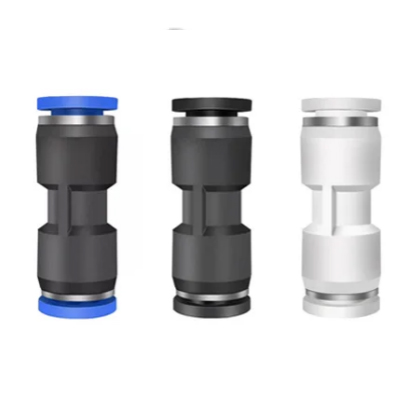
They forget that a Push-to-Connect Pneumatic Fitting is not a surface-level connection. To create a leak-proof seal, the tubing must pass through the stainless steel grab ring and seat deeply inside the internal NBR O-ring.
Depending on the outer diameter (OD) of the tubing, this Insertion Depth is typically between 12mm to 18mm (approx. 1/2 to 3/4 inch) per fitting.
- The Fix: If the physical distance between your fittings is 100mm, and your fitting requires a 15mm insertion depth, your actual cut length must be at least 130mm (100mm + 15mm + 15mm). If you cut it at 100mm, the tube will never reach the O-ring, resulting in a massive air leak.
Factor 2: Minimum Bend Radius & Kinking
Pneumatic tubing cannot make 90-degree sharp turns. Every type of tubing has a Minimum Bend Radius—the tightest curve it can make before the walls collapse and the tube folds flat (known as “kinking”). A kinked tube acts like a blocked artery, instantly choking the airflow and starving your pneumatic cylinders of pressure.
The Material Matters: PU vs. Nylon Tubing
If you are routing lines inside a tightly packed electrical cabinet or a compact robotic arm, the material you choose dictates your bend radius:
- Nylon Tubing: Excellent for high pressure and long, straight factory runs, but it is rigid. Forcing it into a tight corner will snap or kink it.
- Polyurethane (PU) Tubing: The ultimate champion of tight spaces. PU tubing is highly flexible, possesses incredible elastic memory, and boasts a bend radius that is often half that of Nylon.
- The Fix: Always factor in the U-shape or L-shape curve into your total length. If space is restricted, immediately upgrade to premium PU Air Tubing to avoid kinking.
Pro-Tip: The “Dynamic Service Loop” for Moving Cylinders
The formula above is for static lines (components that do not move). But what if your tubing is connected to a pneumatic cylinder that extends and retracts thousands of times a day?
If you measure the tube length while the cylinder is fully retracted, the moment it extends, the tube will be violently ripped out of the fitting.
- The Fix: You must add the Stroke Length of the cylinder to your calculation, plus a generous Dynamic Service Loop (a U-shaped droop). This loop absorbs the kinetic stress of millions of bending cycles. For these high-flex applications, rigid tubing will crack within a week; high-quality Polyurethane (PU) tubing is mandatory.
Factor 3: Tube Volume and Actuator Delay
“If short is bad, I’ll just leave an extra 3 feet of tubing coiled up just in case!”
This is another critical error. Pneumatic tubing acts as a micro-air reservoir. The longer the tube, the greater the internal volume. When a solenoid valve shifts to actuate a cylinder, the compressor must first fill that entire length of tubing before the pressure reaches the cylinder.
- The Result: Noticeable actuator delay and sluggish machine performance.
- The Fix: Once you account for insertion depth and bend radius, keep your tubing as short as safely possible to maximize machine speed and save compressed air.
Pro-Tip: Elevate Your Routing with Color-Coding
Want to make your machine look like it was built by a world-class engineering firm? Stop using just one color of tubing. Implementing a Color-Coded Routing System drastically reduces maintenance downtime:
- Blue Tubing: Standard air supply lines.
- Red Tubing: Cylinder extension (working stroke / high hazard).
- Clear/Transparent Tubing: Vacuum lines (allows you to see if debris has been sucked into the system).
Your Calculations Mean Nothing Without a Perfect Cut
You can use calculators and calipers to determine the exact millimeter of tubing required. But if your technician cuts that tube with a pair of standard scissors or wire cutters, the tube will be crushed into an oval shape. When pushed into a round fitting, that oval tube will leak instantly.
To make your precise calculations count, you must use a professional Pneumatic Tube Cutter. This tool ensures a perfectly round, 90-degree flat cut, guaranteeing a flawless seal against the internal O-ring every single time.
Conclusion: Build Smarter Pneumatic Circuits
Calculating pneumatic tube length is about balancing tension, flow, and volume. By factoring in insertion depth, respecting the bend radius, and adding service loops for moving parts, you eliminate the root causes of 80% of machine air leaks.
Are you ready to route your pneumatic circuits like a pro?
Explore our premium selection of highly flexible Polyurethane (PU) Tubing (available in multiple colors), leak-proof Push-to-Connect Fittings, and the essential Pneumatic Tube Cutters that guarantee a perfect seal.