In the fast-paced world of industrial automation, downtime is the enemy. When a pneumatic cylinder fails on a production line, the last thing you want is to be locked into a single supplier with an 8-week lead time. You need a replacement, and you need it now.
This is where understanding ISO Standards becomes your competitive advantage.
Many buyers assume that if a machine was built with a specific brand of cylinder (like Festo or SMC), they must replace it with the exact same brand. This is a costly misconception. Thanks to international standardization, specifically ISO 15552 and ISO 6432, you have the freedom to choose.
Whether you are an MRO engineer looking for a drop-in replacement or an OEM designer selecting components for a new machine, understanding these standards unlocks global interchangeability, lowers your costs, and ensures you are never held hostage by a single manufacturer’s stock levels.
In this buyer’s guide, we will decode the two most critical standards for pneumatic cylinders—the robust ISO 15552 and the compact ISO 6432—and show you exactly how to select the right one for your application.
1. The Titans of Standardization: ISO 15552 vs. ISO 6432
When selecting a pneumatic cylinder, size and structure are your primary filters. While there are many niche standards, two giants dominate the industrial landscape.
ISO 15552: The Industrial Workhorse (Profile Cylinder)
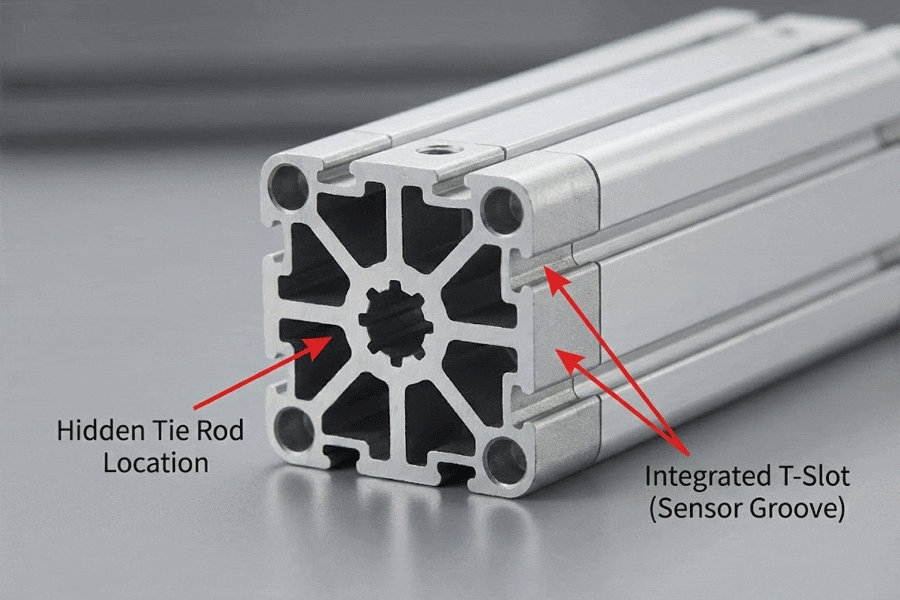
If you see a square-shaped aluminum cylinder on a packaging line or an assembly machine, it is likely an ISO 15552 cylinder. This is the modern standard for “standard cylinders” (formerly ISO 6431), covering bore sizes from 32mm up to 320mm (though the “profile” design is most common up to 125mm).
Key Features:
- Profile Barrel Design: Unlike older “tie-rod” cylinders where four steel rods were visible on the outside, modern ISO 15552 cylinders (especially in sizes 32-125mm) use a clean aluminum profile. This “Mickey Mouse” profile houses the tie-rods internally, creating a smooth surface that is easier to clean and prevents dust buildup.
- Integrated Sensor Grooves: The profile design allows T-slot magnetic sensors to be mounted flush with the body, protecting them from physical damage—a significant upgrade from older bracket-mounted sensors.
- Adjustable Cushioning: These cylinders come equipped with pneumatic cushioning screws at both ends. This allows you to fine-tune the deceleration of heavy loads, reducing impact noise and extending the cylinder’s lifespan.
ISO 6432: The Compact Solution (Mini Cylinder)

For applications where space is tight and loads are lighter, the ISO 6432 mini cylinder is the go-to standard. These are easily recognized by their slim, round bodies and are typically available in bore sizes from 8mm to 25mm.
Key Features:
- Round Stainless Steel Body: The barrel is typically made of stainless steel, offering excellent corrosion resistance, making them ideal for light-duty food or pharmaceutical applications.
- Crimped Construction: The end caps are mechanically crimped onto the barrel. While this makes the unit compact and leak-proof, it also means these cylinders are generally non-repairable. If one fails, you simply replace the unit.
- Threaded Nose & Tail: ISO 6432 cylinders often feature a threaded neck (nose), allowing for versatile mounting directly through a panel.
At a Glance: ISO 15552 vs. ISO 6432
Here is a quick reference guide to help you distinguish between the two:
| Feature | ISO 15552 (Standard Profile) | ISO 6432 (Mini Round) |
|---|---|---|
| Typical Bore Size | 32mm, 40mm, … 320mm | 8mm, 10mm, … 25mm |
| Barrel Shape | Square Aluminum Profile (or Tie-rod >125mm) | Round Stainless Steel Tube |
| Repairability | Repairable (Seals can be replaced) | Non-repairable (Crimped body) |
| Cushioning | Adjustable Pneumatic Cushioning | Rubber Bumpers (Fixed) |
| Primary Use | Heavy automation, high force | Light handling, tight spaces |
| Interchangeability | Replaces old ISO 6431 / VDMA 24562 | Universal mini cylinder standard |
2. The Interchangeability Guide: Replacing Your Old Cylinders
One of the most common questions we receive from maintenance engineers is: “My machine has an old ISO 6431 cylinder. Can I use an ISO 15552 cylinder to replace it?”
The short answer is: Yes, absolutely.
ISO 15552 vs. ISO 6431: A Direct Upgrade
ISO 15552 is essentially the modern evolution of the older ISO 6431 (also known as VDMA 24562). While the external appearance has changed—moving from the old “tie-rod” design to the cleaner “profile” design—the critical mounting dimensions remain identical.
- Mounting Centers: The distance between the mounting holes on the front and rear caps is the same.
- Piston Rod Thread: The thread size on the rod is the same.
- Overall Length: The stroke and retracted length are standard.
This means an ISO 15552 cylinder is a “drop-in replacement” for an ISO 6431 cylinder. You can unbolt the old unit and bolt on the new one without modifying your machine or changing your mounting brackets.
Breaking Free from Brand Lock-in
The beauty of ISO standardization is that it levels the playing field. Major brands like Festo, SMC, and Parker adhere to these standards, which means you can cross-reference part numbers easily.
- Replacing Festo: Whether you have a legacy Festo DNC (an older generation ISO cylinder) or a current DSBC (modern ISO 15552), you can replace it with any high-quality ISO 15552 generic cylinder.
- Replacing SMC: The SMC CP96 (ISO 15552) or C85 (ISO 6432) series are also built to these international standards.
By focusing on the standard rather than the brand label, you can often find replacements with equal performance at a lower cost and with faster availability.
⚠️ PRO TIP: The “Sensor Trap” While the cylinder mechanics are identical, watch out for the sensors!
- Old ISO 6431 (Tie-rod): Usually required sensors to be mounted on the exposed tie-rods using external brackets.
- New ISO 15552 (Profile): Features integrated T-slots. Your old sensors might not fit the new slots.
- Solution: When upgrading from an old tie-rod cylinder to a profile cylinder, we highly recommend purchasing new T-slot magnetic sensors to ensure a flush, secure fit.
3. How to Select the Right Cylinder
Selecting a pneumatic cylinder can feel like deciphering a secret code. A typical part number might look like SI-63-100-S-V. To ensure you order the correct component, you need to know exactly what each segment represents.
Decoding the Part Number
While every manufacturer has slight variations, the structure of an ISO cylinder code generally follows this logic:
[Series] – [Bore Size] – [Stroke Length] – [Magnet] – [Sealing]
- Series: Identifies the standard (e.g., SI or DNC for ISO 15552).
- Bore Size (mm): The diameter of the internal piston. This determines the force (pushing power).
- Stroke Length (mm): How far the piston rod extends.
- Magnet (S): Indicates a magnetic ring is inside the piston for sensor detection.
- Sealing: Standard is usually blank; V often stands for Viton (High Temp).
The Buyer’s Checklist: 5 Specs You Must Check
Before you click “Add to Cart,” verify these five critical specifications to avoid costly returns or failures.
1. Bore Size (Force): Does the cylinder have enough power to move your load?
- Rule of Thumb: Always calculate the force required based on your air pressure (usually 6 bar).
- Common Mistake: guessing the size. A 32mm bore produces significantly less force than a 40mm bore. If you are replacing a cylinder, measure the internal barrel diameter or the piston rod diameter to cross-reference.
2. Stroke Length: This is the distance the rod travels. ISO cylinders come in standard strokes (e.g., 25, 50, 80, 100mm), but custom strokes are possible.
- Note: For very long strokes (>1000mm), ensure the piston rod is thick enough to avoid buckling.
3. Action Type:
- Double Acting (Most Common): Uses air to extend and air to retract. This gives you control and force in both directions.
- Single Acting: Uses air to extend and a spring to return (or vice-versa). Only use these for simple clamping tasks where air consumption needs to be minimized.
4. Magnetic Piston: Always choose a cylinder with a magnet (“S” or “M” in the code). Even if you don’t use sensors today, having the internal magnet makes your cylinder “future-proof” for automation updates. The cost difference is negligible, but adding it later is impossible.
5. Seals & Environment (The Hidden Killer): Standard cylinders use NBR (Nitrile) seals, which are perfect for general factory air.
- High Temperature? If your machine runs near ovens or hot molds (>80°C), you must specify Viton (FKM) seals. Standard NBR seals will harden and fail in weeks under high heat.
- Food & Bev? Look for food-grade grease and stainless steel rods.
4. Don’t Forget the Hardware (Mounting Accessories)
A pneumatic cylinder is useless if you can’t attach it to your machine. The beauty of the ISO standard extends beyond the cylinder itself—it covers the mounting accessories too.
This means a clevis bracket from an ISO 15552 cylinder will fit any brand of ISO 15552 cylinder. You don’t need to throw away your existing brackets just because you changed cylinder brands.
Must-Have Accessories:
- Foot Mounting (LB) & Flange (F/R): The standard choice for rigid, linear movement.
- Rear Clevis & Eye (CB/CR): Essential if the cylinder needs to pivot or arc during its stroke.
- Floating Joint (The Life-Saver): If your load isn’t perfectly aligned with the cylinder rod, side-loading can destroy the seals in months. A Floating Joint acts like a flexible coupling, absorbing misalignment and significantly extending your cylinder’s lifespan.
FAQ: Common Buyer Questions
Q: What is the difference between ISO 15552 and ISO 21287? A: ISO 15552 covers standard “profile” cylinders with long strokes. ISO 21287 covers compact (short-stroke) cylinders. If you have very limited space and need a short, flat cylinder, look for ISO 21287 instead.
Q: Can I repair an ISO 6432 mini cylinder? A: Generally, no. ISO 6432 cylinders typically have crimped (rolled) end caps, meaning they cannot be disassembled without destroying them. They are designed to be cost-effective, disposable units. ISO 15552 cylinders, however, are fully repairable with seal kits.
Conclusion: Choose Freedom, Choose ISO Standards
Understanding ISO 15552 and ISO 6432 is about more than just technical specs—it’s about supply chain freedom.
By standardizing your pneumatic components, you protect your operation from long lead times and brand-specific price markups. Whether you are building a new machine or keeping an old one running, ISO standards ensure you always have a “drop-in” solution ready.
Not sure about the crossover?
Don’t guess. [Contact our Engineering Team] with your old part number, and we’ll identify the exact ISO equivalent for you today.