1. Introduction: The Hidden Cost of the Wrong Tube
Did you know that a single 1/16” air leak can cost an industrial plant over $800 per year in wasted energy?
When we find a leak in an industrial pneumatic system, we often blame the fittings. We tighten them, tape them, or replace them. But what if the problem isn’t the connection, but the pneumatic tubing itself?
Choosing the wrong tubing material is one of the most common—and expensive—mistakes in automation design. Using a rigid tube in a moving robotic arm can lead to kinking and airflow blockage. Conversely, using a cheap, non-resistant hose in a humid environment can cause the tube to crack and fail within months.
In this guide, we will break down the three most popular materials for industrial air hoses: Polyurethane (PU), Nylon (PA12), and Polyethylene (PE). We’ll help you understand their differences, so you can choose the right solution to maximize your system’s efficiency and ROI.
2. The Quick Identification Guide: How to Tell Them Apart
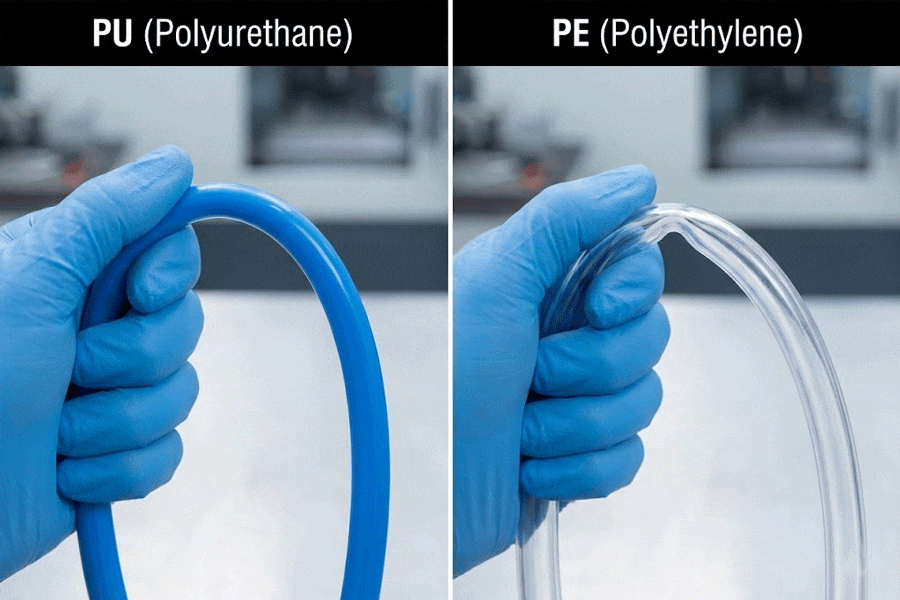
Often, maintenance teams inherit a machine with old, unlabeled tubing and aren’t sure what to order as a replacement. If you have a piece of the old tubing in your hand, here is a simple “Touch Test” to identify the material:
- Polyurethane (PU):
- The Feel: It feels rubbery and slightly “grippy” to the touch.
- The Bend: It is extremely flexible. If you pinch it or fold it over, it tends to spring back to its original round shape immediately (excellent memory).
- Nylon (PA12):
- The Feel: It feels hard, rigid, and smooth—more like a hard plastic pipe than a hose.
- The Bend: It is stiff and difficult to bend by hand. It resists tight curves.
- Polyethylene (PE):
- The Feel: It has a distinct “waxy” or slippery texture.
- The Bend: If you kink it, it “dies.” It stays bent and usually leaves a permanent white stress mark at the fold point.
3. Polyurethane (PU) Tubing: The Automation Standard
For 80% of modern industrial automation applications, Polyurethane (PU) tubing is the superior choice. It bridges the gap between rubber and plastic, offering the flexibility of rubber with the durability of engineering plastic.
Why It’s the Best Choice for Automation
- Extreme Flexibility & Memory: The standout feature of PU tubing is its kink resistance. In applications involving robotic arms, pick-and-place machines, or drag chains where tubing is constantly flexing, PU is essential. Even after repeated bending, it returns to its original shape without restricting airflow. This small bend radius allows for compact piping in tight control cabinets.
- “Grippy” Installation: Due to its rubbery texture, PU tubing grabs onto push-to-connect fittings tightly, acting like a “Chinese finger trap.” This creates a secure, leak-free seal that resists vibration.
The “Pro” Insight: Ether-based vs. Ester-based PU
Not all PU tubing is created equal. This is where many buyers get burned.
- Ester-based PU: Cheaper but prone to hydrolysis. In humid environments (like tropical factories or near water lines), moisture attacks the material, causing it to crumble and crack over time.
- Ether-based PU (Recommended): High-quality PU tubing (like ours) is typically Ether-based. It is immune to hydrolysis, resists fungus, and maintains stability in humid conditions. If you want long-term reliability, always confirm you are buying Ether-based PU.
4. Nylon (PA12) Tubing: The Pressure Warrior
While PU is the king of flexibility, Nylon (specifically Polyamide 12 or PA12) is the king of pressure and chemical resistance. It is a harder, semi-rigid material that is often used where higher performance metrics are required.
When to Choose Nylon
- High Pressure & Stability: Nylon tubing typically handles higher working pressures and temperatures than PU. If your system runs at the upper limits of standard pneumatic pressure, Nylon offers an extra safety margin.
- Chemical Resistance: PA12 has excellent resistance to solvents, fuels, and oils, making it a preferred choice for harsh industrial environments or even some hydraulic applications.
The Drawback: Rigidity
The trade-off for this strength is stiffness. Nylon has a much larger bend radius compared to PU. If you try to force Nylon tubing into a tight curve inside a compact machine, it puts significant stress on the fittings and can eventually fatigue or kink permanently.
The Verdict: Use Nylon for main air distribution lines or straight runs where the tubing does not need to move. For dynamic applications or inside control boxes, it is usually too stiff to work with effectively.
5. Polyethylene (PE) Tubing: The Economy Option
Polyethylene (PE) is often found in laboratory settings or low-cost pneumatic kits. It is widely recognized as the budget-friendly option, but it comes with significant limitations for industrial machinery.
The Pros: Cost and Chemistry
- Chemical Inertness: PE is highly resistant to a wide range of chemicals and contaminants. It is often food-safe (FDA compliant) and is excellent for water transfer or liquid lines where purity is a concern.
- Low Cost: It is generally the cheapest of the three materials, making it attractive for hobbyists or large-scale, low-pressure installations where budget is the primary driver.
The Warning: Poor Memory
The biggest downside of PE for automation is its lack of flexibility. It has very poor “memory.”
- Kinking Issues: If PE tubing is bent too sharply, it doesn’t just resist; it kinks and collapses, leaving a permanent white stress mark. Once kinked, the tube is permanently damaged and restricts airflow.
- Vibration Sensitivity: Unlike PU, which absorbs vibration, PE connections can loosen over time in high-vibration environments.
The Verdict: PE is fine for static, low-pressure applications or liquid transfer. However, for industrial automation where reliability is key, the cost savings are rarely worth the risk of kinking and leaks.
6. Critical Selection Factors: A Buyer’s Checklist
Deciding on the material is step one. To ensure your system runs smoothly and safely, you must also consider these three critical factors before placing an order.
1. The Safety Factor (3:1 Rule)
Never choose tubing based solely on its “Working Pressure.” A safe industrial system requires a safety margin.
- The Rule: Most reputable manufacturers follow a 3:1 Safety Factor. This means if your system operates at 150 PSI, the tubing should have a Burst Pressure of at least 450 PSI.
- Always check the datasheet for the Burst Pressure at elevated temperatures, as pressure ratings drop significantly as the environment gets hotter.
2. Sizing: Metric vs. Imperial
This is the most common cause of air leaks. Metric (mm) and Imperial (inch) tubing may look similar, but they are not interchangeable.
- For example, 6mm tubing is significantly smaller than 1/4″ (6.35mm) tubing. Inserting a 6mm tube into a 1/4″ push-to-connect fitting will prevent the internal O-ring from sealing properly, resulting in a leak.
- Pro Tip: Always match your tubing standard to your machine’s origin. European and Asian machines typically use Metric, while US-built equipment often uses Imperial.
3. Organization: The Power of Color-Coding
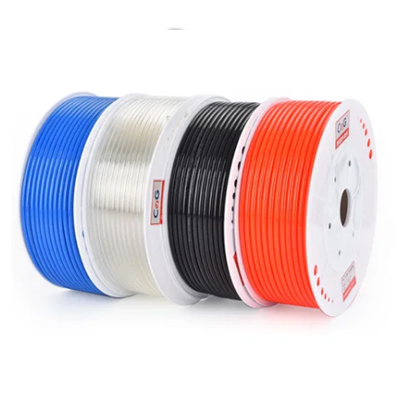
Don’t settle for just “Clear” or “Black” tubing. Utilizing color-coded PU tubing can drastically reduce maintenance time.
- Blue: Supply Air.
- Red: Exhaust/Discharge.
- Black: Control Signals.
- Yellow/Green: Safety Circuits. By visualizing your circuit, technicians can troubleshoot problems in seconds rather than minutes.
7. Conclusion & Recommendation
A pneumatic system is only as strong as its weakest link. You can have the most expensive valves and cylinders in the world, but if your air lines are leaking or kinking, your machine’s performance will suffer.
Here is the final verdict:
- Choose Nylon (PA12) if you need high pressure handling and chemical resistance for stationary main lines.
- Choose Polyethylene (PE) if you are on a strict budget for simple, low-pressure liquid or air transfer.
- Choose Polyurethane (PU) for almost all industrial automation, robotics, and control cabinets where flexibility, kink resistance, and tight bend radii are required.
Don’t let a $1 tube ruin a $50,000 machine. Investing in high-quality, Ether-based PU tubing is one of the cheapest insurance policies you can buy against downtime and air leaks.
Ready to upgrade your pneumatic lines? Check out our full range of High-Flex Industrial PU Tubing, available in both Metric and Imperial sizes with a wide variety of colors for easy circuit management.