In the world of industrial automation, the pneumatic cylinder is the muscle behind the movement. Whether you are clamping parts in a fixture, pushing heavy loads on a conveyor, or operating a robotic gate, selecting the right actuator is critical.
But there is one fundamental question that stumps many engineers and procurement managers during the design phase: “Do I need a single acting or a double acting cylinder?”
It might seem like a small detail, but making the wrong choice can lead to wasted compressed air energy, unnecessarily complex plumbing, or even critical safety hazards during a power outage.
To understand the difference instantly, think of it simply:
- A Single Acting Cylinder is like a rubber band—you stretch it out, and it snaps back on its own.
- A Double Acting Cylinder is like a bicycle pump—you have to use force to push the handle out and force to pull it back in.
In this guide, we will break down the technical differences between single acting vs. double acting pneumatic cylinders. We’ll go beyond the basics to analyze the costs (including hidden energy savings), safety implications, and help you decide exactly which type is right for your application.
What is a Single Acting Pneumatic Cylinder? (The Fail-Safe Choice)
As the name implies, a single acting pneumatic cylinder uses compressed air to move in only one direction.
The mechanism is straightforward: compressed air enters through a single port to extend the piston rod (the power stroke). Once the air supply is cut off or exhausted, an internal mechanical spring pushes the piston back to its original position.
While most standard models are “Spring Return” (air extends, spring retracts), you can also find “Spring Extend” versions depending on your specific needs. These are commonly found in compact designs like the ISO 6432 Mini Cylinder series.
Why Choose Single Acting?
The biggest advantage of a single acting cylinder isn’t just simplicity—it is safety.
In engineering terms, this is known as a “Fail-Safe” component. If your factory suddenly loses power or the air compressor fails, the cylinder will automatically return to its home position via the spring force. This is critical for applications like safety clamps or emergency shut-off valves, where you need the machine to “fail” into a safe state rather than dropping a heavy load.
⚠️ Pro Tip: Don’t Forget the Breather Port!
This is the #1 mistake we see with new installations. Since air is only entering one side of the cylinder, the other side needs to “breathe” to prevent a vacuum from forming. Most single acting cylinders have a small vent port on the spring side.
Crucial Advice: Never plug this port! Instead, install a small sintered bronze breather filter. This prevents dust and moisture from being sucked into the cylinder chamber as the spring retracts, which is the leading cause of spring corrosion and seal failure.
What is a Double Acting Pneumatic Cylinder? (The Industry Standard)
If the single acting cylinder is a specialist, the double acting pneumatic cylinder is the workhorse of the automation world. It is the most common type you will find in factories today (such as the standard ISO 15552 Tie-Rod Cylinder).
Unlike its single acting counterpart, a double acting cylinder has no internal spring. Instead, it features two air ports. Compressed air is applied to one port to extend the piston, and to the opposite port to force it back in.
This design fundamentally changes how the cylinder performs:
- Multi-Directional Power: You get powered force in both directions. This makes double acting cylinders ideal for “Push-Pull” applications, such as opening and closing heavy gates.
- Longer Stroke Capabilities: Since there is no mechanical spring to take up space or limit movement, double acting cylinders can be manufactured with unlimited strokes—some reaching up to several meters in length.
- Precise Speed Control: With a double acting cylinder, you can install flow control valves on both ports to precisely adjust how fast the cylinder extends and how fast it retracts.
Key Differences: Side-by-Side Comparison
To help you make a quick decision, here is a direct comparison of the two technologies across critical performance metrics.
| Feature | Single Acting Cylinder | Double Acting Cylinder |
|---|---|---|
| Force Generation | One direction only (Push OR Pull). | Both directions (Push AND Pull). |
| Force Output | Reduced (Internal spring fights the air pressure). | Consistent and full force. |
| Air Consumption | Low (Uses air only for the power stroke). | High (Uses air for both extend and retract). |
| Stroke Length | Limited (Usually < 100mm). | Unlimited (Can reach 2000mm+). |
| Valve Required | Simple 3/2-Way Valve. | Standard 5/2-Way Valve. |
| Fail-Safe | Yes (Returns to home on power loss). | No (Stops in place or drifts). |
Critical Analysis: Two Factors You Must Know
While the table summarizes the basics, two technical factors often catch engineers off guard:
1. The “Spring Tax” on Force Output If you choose a single acting cylinder, remember that the compressed air isn’t just pushing the load; it also has to compress the internal spring.
- The Result: A single acting cylinder will typically deliver 10% to 20% less force than a double acting cylinder of the same bore size.
- The Fix: You may need to “oversize” the bore (e.g., use a 40mm bore instead of 32mm) to compensate for the spring resistance.
2. The 50% Energy Savings Calculation For high-cycle applications (like packaging machines doing 60 cycles per minute), air consumption is a major operating cost.
- A double acting cylinder consumes a full volume of compressed air to extend and another full volume to retract.
- A single acting cylinder uses air only once per cycle. The return stroke is “free” (powered by the spring).
- Bottom Line: Switching to single acting for simple clamping tasks can instantly cut your compressed air energy bill by roughly 50%.
How to Choose: The 3-Step Decision Matrix
Still on the fence? To select the right cylinder for your specific application, simply answer these three questions in order.
Step 1: The Safety Test (What happens when the air cuts off?)
Imagine your air compressor fails or the electricity goes out right now.
- Scenario A: The cylinder must immediately retract to a safe position to prevent a crash, unlock a door, or stop a conveyor.
- ✅ Choose: Single Acting. The mechanical spring guarantees a return to the “home” position without any external power.
- Scenario B: It is acceptable (or required) for the cylinder to stay exactly where it is, or drift freely.
- ✅ Choose: Double Acting.
Step 2: The Force & Stroke Test
- Do you need to pull a heavy load? If yes, choose Double Acting. Remember, a single acting cylinder has very weak pulling power because the spring is only designed to move the piston rod itself, not a heavy external load.
- Is the stroke longer than 100mm? If yes, choose Double Acting. Springs get long and buckle easily inside the barrel.
Step 3: The Vertical Load Test (Gravity is your enemy)
Are you lifting an object up and down?
- The Gravity Trap: If you use a single acting cylinder to lift a weight vertically, the spring might not be strong enough to lift the load and the piston rod against gravity.
- The Solution: For vertical lifting applications, Double Acting is almost always the safer choice because you can use full air pressure to overcome gravity.
System Components: Don’t Buy the Wrong Parts
A pneumatic cylinder is only as good as the control system behind it. Since single and double acting cylinders operate differently, they require distinctly different accessories. Ordering the wrong valve is a common frustration.
For Single Acting Systems:
- The Valve: You need a 3/2-Way Solenoid Valve. (One port for supply, one for the cylinder, one for exhaust).
- The Accessory: Sintered Bronze Breather Filter for the vent port.
- The Plumbing: Requires only one air line.
For Double Acting Systems:
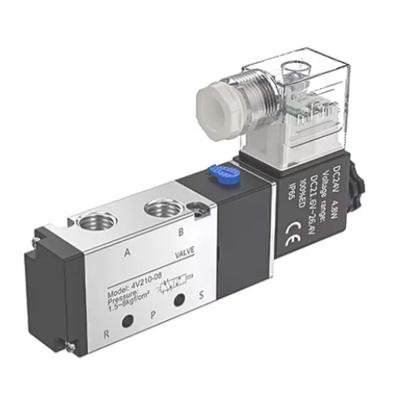
- The Valve: You need a 5/2-Way Solenoid Valve. (Toggles air between the two ports).
- The Accessory: Speed Controllers (Flow Control Valves). Without these, a double acting cylinder will slam into the end caps at full speed.
- The Plumbing: Requires two air lines.
Conclusion: Which One Should You Choose?
There is no absolute winner in the battle of single acting vs. double acting pneumatic cylinders. It all comes down to your specific application requirements.
- Choose Single Acting if: You need a fail-safe solution, are doing simple clamping, and want to reduce air consumption.
- Choose Double Acting if: You need full force in both directions, require long strokes, or need precise speed control.
Still not sure which ISO standard fits your machine? Don’t guess. Our engineering team can help you calculate the exact bore size and force required.
👉 [Contact us for a Free Sizing Consultation]
Frequently Asked Questions (FAQ)
Q: Can I use a double acting cylinder as a single acting cylinder? A: Technically, yes. You can leave one port open to the atmosphere (install a breather filter!) and use air on the other port. However, since there is no internal spring, the cylinder will not retract automatically unless there is an external force pushing it back.
Q: Which cylinder type lasts longer? A: Generally, double acting cylinders have a longer service life. Single acting cylinders are prone to spring fatigue over time—the internal spring can weaken or break after millions of cycles.
Q: Why are single acting cylinders often more expensive? A: It seems counterintuitive since they do “less,” but single acting cylinders contain an additional precision component: the mechanical spring. Manufacturing and installing a high-quality spring inside the barrel adds to the production cost.