Imagine this scenario: You have designed a beautiful pneumatic circuit. Your compressor is providing a solid 6 bar (90 psi) of pressure, and your solenoid valves are perfectly sized. But when you fire up the machine, the two parallel pneumatic cylinders extend sluggishly, or worse, they move completely out of sync.
You check the air supply, you check the valves, but the invisible airflow killer in your machine might actually be a piece of plastic that costs less than a dollar: Your pneumatic splitter fitting.
When branching a compressed air line into two, engineers are constantly faced with a classic fluid dynamics dilemma: Should I use a T-fitting (Union Tee) or a Y-fitting (Union Y)? Both are essential components in automation, but they serve very different purposes. In this guide, we will break down the physics of pressure drop, explain air routing dynamics, and show you exactly how to choose the right push-to-connect plastic fittings to optimize your machine’s airflow and space.
The Physics of Airflow: Pressure Drop and Turbulence
To understand which fitting is better for a specific task, we must first look at how compressed air behaves inside a tube.
Compressed air carries kinetic energy. When it flows through a straight, smooth tube, it travels in organized, parallel layers. This is called laminar flow, and it is highly efficient.
However, every time the air is forced to change direction, it creates turbulence (chaotic, swirling air). Turbulence eats up the kinetic energy, resulting in a Pressure Drop (△ P). The sharper the turn, the higher the pressure drop, and the less flow reaches your pneumatic cylinders.
Y-Fittings (Union Y): The High-Speed, Low-Friction Split
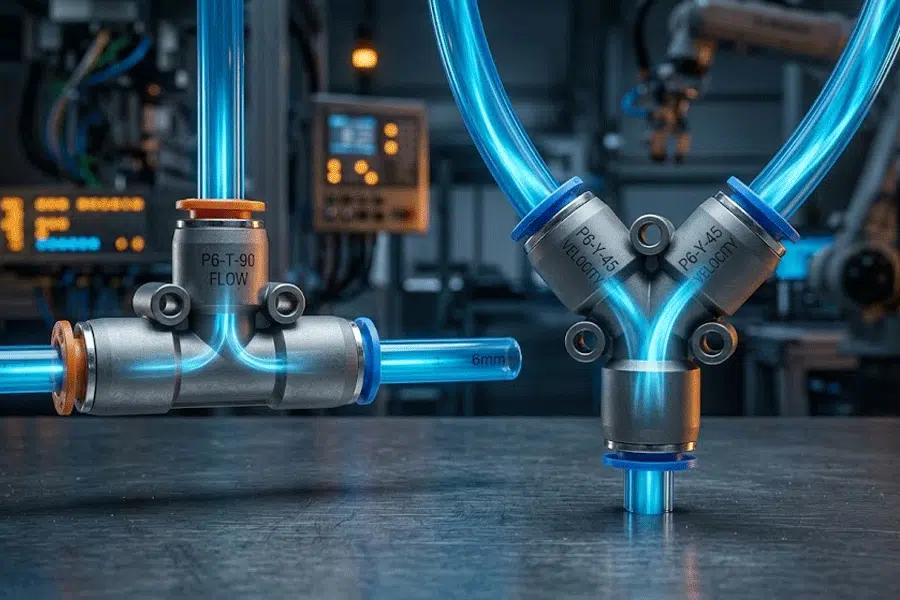
A standard Union Y (Y-fitting or Y-splitter) splits the air at a gentle 45-degree or 30-degree angle.
From a pure aerodynamics perspective, the Y-fitting is built for speed. Instead of hitting a sharp corner, the air glides into the two branches like a car merging onto a highway on-ramp.
- Kinetic Energy Maintained: The smooth internal geometry prevents the air from crashing, allowing it to maintain its velocity.
- Minimal Turbulence: The air maintains its laminar flow state much better than in a 90-degree turn.
- The Result: Y-fittings offer a significantly higher flow coefficient (Cv) and a lower pressure drop. More air reaches your actuators, and it gets there faster.
T-Fittings (Union Tee): The Industry Standard for Compact Design
If Y-fittings have better airflow, why are T-fittings (Union Tees) still the most widely sold pneumatic fittings in the world? Because in modern industrial automation, space is money.
A standard Union Tee splits the air at a sharp 90-degree angle. While this 90-degree deflection creates more internal turbulence (pressure drop) than a Y-fitting, it offers unmatched structural advantages for machine builders:
- Perfect 90-Degree Routing: Industrial machines are built using square aluminum extrusions. T-fittings allow tubes to run perfectly parallel and perpendicular to the machine frame.
- Ultimate Space Saving: They keep the pneumatic tubing tucked tightly against the machine, preventing snag hazards and keeping cable management neat and professional.
- Manifold Building: T-fittings are essential for creating main-line distribution headers where one supply line feeds multiple valves in a row.
Engineers gladly trade a slight drop in airflow for a much cleaner, safer, and compact machine design.
Real-World Applications: When to Choose Which Fitting
As a leading manufacturer of high-quality plastic push-to-connect fittings, we supply millions of both T-fittings and Y-fittings globally. Here is our expert advice on when to specify each type on your BOM (Bill of Materials):
When to Use Y-Fittings (For Speed & Synchronization)
You should absolutely use a Union Y push-fitting when you are splitting air to drive two cylinders that must move at the exact same time (e.g., a dual-cylinder lifting mechanism or a pneumatic parallel gripper). The aerodynamic split ensures both cylinders receive the exact same burst of air simultaneously.
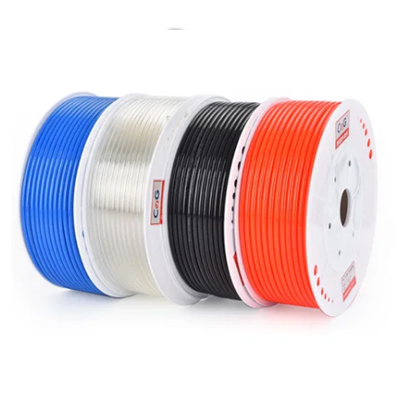
Pro-Tip: The Equal Tubing Rule Even the best Y-fitting cannot save you if your plumbing is wrong. To achieve perfect cylinder synchronization, the two tubes exiting the Y-fitting must be cut to the exact same length. As a one-stop supplier, we recommend pairing our Y-fittings with our high-tolerance PU (Polyurethane) tubing to guarantee leak-free, perfectly synchronized actuation.
When to Use T-Fittings (For Main Lines & Compact Branching)
You should heavily utilize Union Tee push-fittings for your main line branching and whenever space is restricted. If you have one long air supply line feeding three different solenoid valves, T-fittings are the most space-efficient and organized choice.
Pro-Tip: The Reducing Tee Hack To combat the natural pressure drop of a 90-degree turn, do not use the same tube size for everything. Use a Reducing Tee Fitting. Run a large tube (e.g., 10mm or 3/8″) for the main straight line to maintain high volume, and use the smaller 90-degree branch (e.g., 6mm or 1/4″) to drop down to the valve. We stock a massive variety of reducing tee push-fittings specifically designed for this purpose.
Conclusion: Optimize Your Pneumatic Plumbing with the Right Push-Fittings
The difference between a sluggish machine and a high-performance system often comes down to internal airflow and smart routing. Use Y-fittings at the end of your circuit for speed, synchronization, and maximum flow. Use T-fittings at the beginning and middle of your circuit for structured, compact, space-saving air distribution.
Don’t let cheap, poorly molded fittings choke your pneumatic systems. We manufacture premium plastic push-to-connect fittings with optimized internal flow geometries, strong stainless steel lock claws, and high-quality NBR seals.
Whether you need bulk Union Ys, space-saving Reducing Tees, or perfectly calibrated PU tubing, we have the manufacturing capacity to support your OEM needs.
[Send us your pneumatic fitting BOM list today for a competitive factory-direct quote!]