Did you know that air leaks account for up to 30% of energy waste in industrial compressed air systems?
The culprit is often a mismatched or poorly installed connector. In the world of industrial automation, pneumatic fittings (also known as air line connectors) are the unsung heroes. Choosing the right fitting isn’t just about connecting Tube A to Port B—it’s about ensuring system safety, preventing costly downtime, and maintaining optimal pressure.
Whether you are designing a new robotic arm or repairing a leaking air line, this guide covers everything you need to know. We will break down the differences between push-to-connect vs. compression fittings, demystify the confusing world of NPT vs. BSP thread standards, and provide a step-by-step guide to a leak-free installation.
1. Common Types of Pneumatic Fittings: Which One Do You Need?
Pneumatic fittings come in various shapes and locking mechanisms. Selecting the right type depends entirely on your application’s pressure, vibration levels, and need for frequent disconnection.
Push-to-Connect Fittings (Push-In)
Also known as: One-touch fittings, Instant fittings
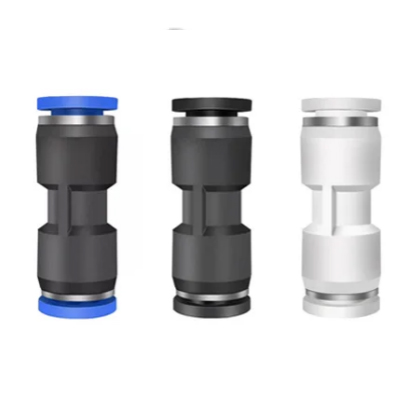
This is the most popular type for standard industrial automation. As the name suggests, you simply push the tubing into the fitting to lock it in place.
- Best For: Applications requiring frequent assembly/disassembly, general pneumatic systems, and tight spaces.
- Key Benefit: Speed. No tools are required for installation.
- Limitation: Not recommended for ultra-high pressure or excessive vibration environments.
- Popular Configurations:
- Male Elbow: For 90-degree turns.
- Union Tee: For splitting air flow.
- Bulkhead Union: For passing air lines through control panels.
[Image Suggestion]: A high-quality photo of a Push-to-Connect fitting with an arrow pointing to the “Release Ring,” labeled “Easy Disconnection.”
Alt Text: Push to connect pneumatic fitting showing release ring mechanism.
Compression Fittings
Also known as: Ferrule fittings
If your equipment vibrates heavily (like a shaking compressor) or uses rigid metal tubing (copper/aluminum), a push-in fitting might accidentally release. Compression fittings solve this by using a nut and a ferrule (ring) to “bite” onto the tube, creating a permanent, heavy-duty seal.
- Best For: High-vibration environments, higher pressures, and rigid tubing.
- Key Benefit: Extreme retention force (The tube will not blow out).
Barbed Fittings
Also known as: Hose tails, Hose barbs
These are the classic connectors used with soft rubber hoses. The ridges (barbs) grip the inside of the hose.
- Important: You must use a hose clamp (worm gear clamp) over the barb to secure the connection. Without a clamp, the hose will pop off under pressure.
- Best For: Low-pressure water or air lines using soft, flexible rubber hoses.
Function-Specific Fittings
Sometimes, you need a fitting that does more than just connect.
- Speed Controllers (Flow Control Valves): These have a built-in knob to adjust the airflow, allowing you to control the speed of a pneumatic cylinder.
- Check Valves (Non-Return): Allow air to flow in only one direction, preventing backflow.
- Rotary Joints: Designed for rotating equipment (like robotic arms) to prevent tubing from twisting and kinking.
2. Understanding Thread Standards: NPT vs. BSP vs. Metric
The most common reason for leaking fittings isn’t poor quality—it’s mismatched threads.
Globally, pneumatic systems primarily use two competing standards: NPT (American) and BSP (British/European/Asian). While they may look similar to the naked eye, their thread angles and pitches are different. Forcing an NPT fitting into a BSP port will damage the threads and cause permanent leaks.
NPT (National Pipe Taper)
- Region: Primarily used in the USA and Canada.
- Design: The threads are tapered (cone-shaped). As you tighten the fitting, the threads compress against each other to form a seal.
- Sealing: Requires PTFE tape (Teflon tape) or pre-applied thread sealant to ensure a leak-free connection.
- Thread Angle: 60°.
BSP (British Standard Pipe)
- Region: Used in Europe, Asia, Australia, and most of the world.
- Two Main Types:
- BSPT (R Thread): Tapered thread, similar to NPT but with a 55° angle.
- BSPP (G Thread): Parallel thread (straight).
- Sealing: BSPP (G) fittings rely on a rubber O-ring or a bonded washer to seal against the face of the port. They do not rely on the threads themselves for sealing.
[Image Suggestion]: A side-by-side diagram comparing NPT (Tapered 60°) vs BSPP (Parallel 55° with O-ring).
Alt Text: Diagram showing difference between NPT and BSP thread angles.
How to Identify Your Thread Type
If you have a mystery fitting and aren’t sure what standard it is, look for these visual clues:
- Check for an O-Ring: If the thread is straight and has a rubber O-ring at the base, it is almost certainly BSPP (G Thread).
- Check the Taper: If the thread gets visibly wider towards the back, it is likely NPT or BSPT.
- Check the Hex Body: Often, markings will indicate the type (e.g., “1/4 NPT” or “R 1/8”).
Pro Tip: Never rely on “forcing it.” If a fitting can only screw in 1-2 turns by hand and then gets stuck, the thread pitch is likely mismatched. Stop immediately.
3. Material Selection: Plastic, Brass, or Stainless?
Choosing the right body material is crucial for the longevity of your pneumatic system.
- Plastic / Polymer (PBT, POM): Best for standard indoor automation. It is lightweight and cost-effective but can degrade under direct UV sunlight.
- Nickel-Plated Brass: The industry standard for general machinery. The nickel plating provides superior corrosion resistance compared to raw brass and is highly durable.
- Stainless Steel (304 / 316): Essential for Food & Beverage, Medical, or Washdown areas. It offers excellent chemical resistance but comes at a higher cost.
Looking for a deep dive on chemical compatibility? Check out our detailed Material Selection Guide to choose the perfect match for your environment.
Don’t Forget the Seals (O-Rings)!
While the body material matters, the internal seal is often the first point of failure.
- NBR (Nitrile Rubber): Standard for air and water. Good for temps up to ~80°C (176°F).
- FKM (Viton): Required for high-temperature applications (up to ~150°C/300°F) or when specific chemicals are present.
4. Installation Guide: How to Guarantee a Leak-Free Connection
Even the most expensive fitting will leak if installed incorrectly. Follow this “Zero-Leak Protocol” to ensure a perfect seal every time.
Step 1: Cut the Tubing Square (Crucial!)
90% of leaks are caused by a bad cut.
- Don’t use scissors or wire cutters. They crush the tube into an oval shape, creating gaps.
- Do use a dedicated tube cutter.
- The Standard: The cut must be perfectly 90° and the cross-section must be circular.
[Image Suggestion]: “Good Cut vs. Bad Cut” comparison photo.
Alt Text: Correct vs incorrect pneumatic tubing cut for push in fittings.
Step 2: Deburr and Clean
Check the cut end for any burrs (rough edges). A sharp burr can scratch the internal O-ring of the fitting during insertion, causing a permanent leak.
Step 3: The “Push-Check” Method (For Push-in Fittings)
Installing a push-in fitting isn’t just “push and done.” Use this 3-stage technique:
- Insert: Push the tube in until you feel resistance. (This is the tube hitting the gripping claw).
- Push Again: Push harder to pass the internal O-ring. You should feel a distinct second “thud” as it hits the tube stop.
- Pull Back: Gently pull the tube back. The claws should dig in and prevent it from coming out. If you can pull it out, it wasn’t installed.
5. Troubleshooting: Why is My Air Line Leaking?
If you hear that dreaded hissing sound, check these three common culprits before replacing the entire system.
| Problem | Likely Cause | The Fix |
|---|---|---|
| Leak at the tube entry | Tube is scratched or cut at an angle. | Remove tube, re-cut 1 inch off the end (squarely), and re-insert. |
| Leak at the thread | Mismatched threads (e.g., NPT in BSP) or lack of sealant. | Check thread type. If compatible, re-apply PTFE tape (wrap 2-3 times clockwise). |
| Tube blows out | Pressure too high or tube too soft. | Check if you are using soft PU tubing in a high-pressure application. Switch to rigid Nylon (PA) tubing or use a Compression Fitting. |
| Fitting is “Stuck” | Internal claw is biting too deep. | Push the tube in first to release tension, then press the release ring evenly before pulling. |
6. Summary & Buying Checklist
Pneumatic fittings are small components that carry a big responsibility. Whether you need the speed of a push-to-connect fitting or the durability of stainless steel, choosing the right spec is the key to an efficient, leak-free facility.
Ready to Order? Use This Checklist
To get the fastest and most accurate quote from your supplier, make sure to specify these 5 points in your inquiry:
- Media: What is flowing? (Air, Water, Oil, or Chemicals?)
- Pressure & Temp: Max PSI and Operating Temperature.
- Tube Size: Metric (e.g., 6mm, 8mm) or Imperial (e.g., 1/4″, 3/8″)?
- Thread Type: NPT, BSPP (G), or BSPT (R)?
- Environment: Standard factory? (Use Brass/Plastic) or Food/Washdown? (Use 316 Stainless Steel).
Stop Paying for Air Leaks.
Need a reliable supplier who understands the difference between NPT and BSP? We stock a full range of high-performance pneumatic fittings compatible with major brands like SMC and Festo—at a fraction of the cost. Contact us now!