If you have ever watched a pneumatic cylinder extend and noticed it moving in a jerky, stuttering, or jumping motion instead of a smooth glide, you have witnessed the enemy of precision automation: Stiction.
Short for “static friction,” stiction is one of the most frustrating challenges for mechanical engineers and maintenance technicians. When an actuator suffers from stiction, it becomes impossible to achieve accurate positioning, smooth low-speed operation, or delicate force control. In applications like medical device assembly, fluid dispensing, or wafer handling, that sudden “jerk” can destroy thousands of dollars worth of fragile components in a fraction of a second.
This guide breaks down the physics behind the stick-slip phenomenon, uncovers the hidden causes of jerky cylinder movement, and provides actionable engineering solutions—from quick pneumatic hacks to specifying the ultimate low-friction pneumatic cylinders.
The Physics of the “Jerk”: What Exactly is Stiction?
To fix the problem, you must understand the physics. Stiction is born from the battle between two types of friction inside the cylinder barrel:
- Breakaway Friction (Static Friction): The force required to start moving the piston from a complete stop.
- Dynamic Friction (Kinetic Friction): The force required to keep the piston moving once it has started.
The Golden Rule of Friction: Static friction is almost always higher than dynamic friction.
When compressed air enters the cylinder, pressure builds up behind the piston because the seals are “stuck” to the cylinder wall. The pressure continues to rise until it is finally high enough to overcome the breakaway friction. Suddenly, the piston breaks free. Because dynamic friction is much lower, the built-up compressed air rapidly expands, causing the piston rod to violently “snap” or “jerk” forward. The pressure then drops, the piston stops (sticks) again, and the cycle repeats. This is the classic stick-slip phenomenon.
The 4 Hidden Causes of Pneumatic Cylinder Stiction
If your air cylinder is jumping, it is usually suffering from one (or a combination) of these four issues:
1. Seal Swelling and Lubrication Loss
Standard pneumatic cylinders use NBR (Nitrile) or polyurethane lip seals. Over millions of cycles, the factory-applied grease washes away. Without a lubricating film, the dry rubber seal creates massive friction against the aluminum or steel barrel. Additionally, if incompatible oils or chemicals enter the air line, the rubber seals can swell, further increasing the breakaway friction.
2. Extremely Low Operating Speeds
Pneumatic cylinders are inherently designed to move fast. If you try to run a standard cylinder at an extremely low speed (e.g., less than 20 mm/second) by heavily restricting the airflow, the cylinder will almost certainly stutter because there isn’t enough continuous kinetic energy to overcome the friction threshold.
3. Oversized Cylinders Operating at Low Pressure
This is a common sizing mistake. Engineers often specify a larger bore cylinder “just to be safe.” However, a larger bore means a much larger rubber seal circumference rubbing against the barrel. If you operate this oversized cylinder at a very low air pressure, the weak pushing force will struggle to overcome the massive static friction, resulting in severe stiction.
4. Side Loading and Misalignment
Sometimes, the stiction isn’t the cylinder’s fault; it’s the mechanical installation. If the load is not perfectly aligned with the piston rod, it creates a side load. This forces the internal piston and rod bearing to scrape hard against one side of the cylinder wall, artificially amplifying the friction.
How to Eliminate Stiction: From Quick Fixes to Permanent Upgrades
Depending on your budget and application requirements, here is how you can cure the stick-slip phenomenon:
Quick Fix 1: The “Meter-Out” Flow Control Hack
The Engineer’s Secret: Never restrict the air entering the cylinder to control its speed. If you restrict the inlet, the cylinder will jump. Instead, use a meter-out speed controller (flow control valve) on the exhaust port. By restricting the air leaving the cylinder, you create a pocket of pressurized back-pressure. The piston is now clamped tightly between two “air springs,” which heavily dampens the jerky movement and forces a smoother stroke.
Quick Fix 2: Install an Air Line Lubricator (FRL)
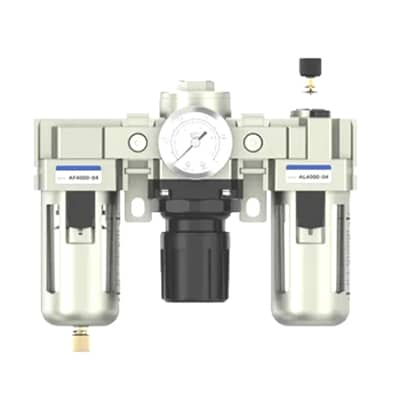
If the factory grease has washed away, the cheapest fix is to reinstall a lubricating film. Add a pneumatic lubricator (part of an FRL unit) upstream of the valve. Injecting a micro-mist of lightweight pneumatic oil into the air stream will significantly lower the breakaway friction of the dry seals.
Quick Fix 3: Add a Floating Joint (Rod Alignment Coupler)
If side loading is causing the stiction, do not rigidly bolt the cylinder rod to the moving load. Install a floating joint (rod alignment coupler) at the end of the piston rod. This clever mechanical accessory absorbs radial and angular misalignment, ensuring the cylinder pushes in a perfectly straight line without scraping the internal walls.
The Ultimate Fix: Upgrade to Low-Friction Pneumatic Cylinders
For applications demanding ultra-smooth, low-speed actuation or precise tension control, standard cylinders and quick hacks are not enough. You must upgrade the hardware.
A true low-friction pneumatic cylinder is engineered differently from the ground up:
- Specialized Seals: They replace standard rubber lip seals with specialized PTFE (Teflon) or proprietary low-friction elastomer seals. PTFE has one of the lowest coefficients of friction of any solid material.
- Honed Barrels: The internal cylinder barrel is micro-honed to a mirror-like finish to eliminate microscopic surface roughness.
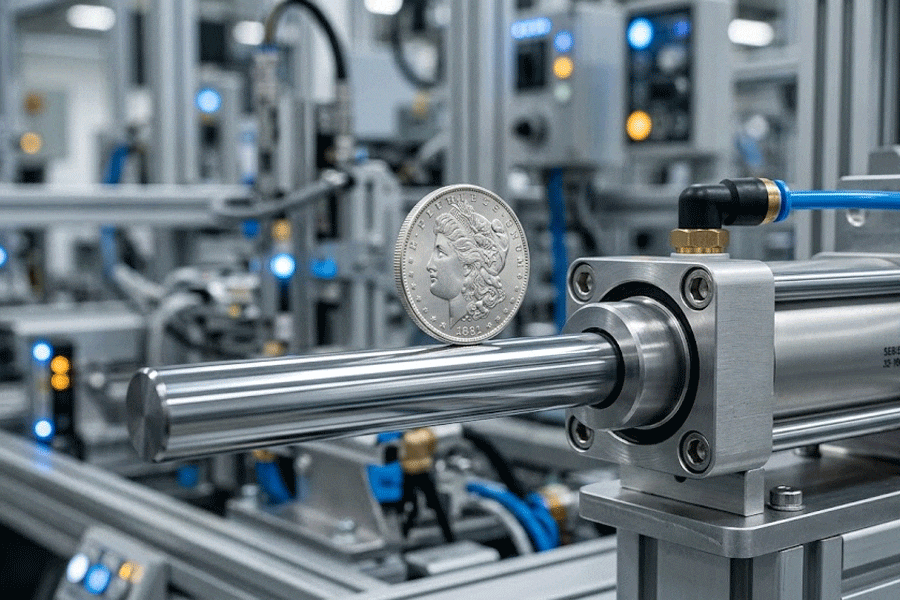
- The “Coin Test”: A premium low-friction cylinder operates so smoothly that you can balance a coin on the actuator during a low-speed stroke without it falling over. The breakaway friction is nearly identical to the dynamic friction, completely eliminating the stick-slip phenomenon.
Conclusion: Smooth Actuation Starts with the Right Sourcing
Stiction is a complex physical problem, but it is entirely solvable with the right pneumatic components. Whether you need to regulate exhaust back-pressure, compensate for misalignment with floating joints, or completely re-engineer your machine with precision low-friction cylinders, standard off-the-shelf parts often fall short.
Stop fighting jerky cylinders and ruining expensive products. As a dedicated manufacturer of premium pneumatic components, we supply high-precision FRL units, meter-out speed controllers, and specialized low-friction pneumatic cylinders designed for your most demanding, low-speed applications. [Contact our engineering team today!]